Support our educational content for free when you purchase through links on our site. Learn more

Did you know that a single teaspoon of healthy soil holds more living organisms than there are people on Earth? Yet, for decades, we treated our urban dirt as mere dirt, unaware that beneath our feet lay a silent, powerful engine capable of reversing climate change. At Community Gardening™, we’ve watched neighbors transform neglected lots into lush, carbon-hoarding sanctuaries, proving that the fight against global warming doesn’t always require high-tech labs—it often starts with a simple shovel and a commitment to no-till practices. In this deep dive, we’ll uncover the surprising science behind how your plot of tomatoes and kale can act as a massive carbon sink, debunk the myth that small gardens don’t matter, and reveal the 7 specific techniques you can start using today to lock carbon away for centuries.
Key Takeaways
- Soil is a Super-Sink: Healthy community gardens can sequester significantly more carbon than previously thought, acting as vital urban carbon reservoirs when managed with regenerative practices.
- Stop Tilling, Start Storing: The single most impactful change you can make is to eliminate soil disturbance, preserving fungal networks that lock carbon deep underground.
- Biodiversity Drives Capture: Planting a diverse mix of perennials, cover crops, and deep-rooted vegetables maximizes the amount of carbon your garden pulls from the atmosphere.
- Community Power: Small plots add up; the collective impact of thousands of local gardens creates a measurable, city-wide reduction in greenhouse gases.
- Actionable Steps: From biochar application to mulching strategies, we provide a step-by-step guide to turning your garden into a climate solution.
Table of Contents
- ⚡️ Quick Tips and Facts
- 🌱 From Dirt to Data: The History of Carbon Sequestration in Community Gardens
- 🧪 The Science of Soil: How Community Gardens Act as Carbon Sinks
- 🌿 Top 7 Soil Management Techniques to Maximize Carbon Capture
- 🥕 The Plant Power List: Best Carbon-Hoarding Crops for Your Plot
- 🐛 Beneath the Surface: The Critical Role of Soil Microbiomes in Carbon Storage
- 💧 Water Wisdom: Irrigation Strategies That Protect Stored Carbon
- 🚫 Common Pitfalls: What Destroys Carbon in Community Gardens?
- 📊 Measuring Success: Tools and Methods for Tracking Your Garden’s Carbon Footprint
- 🤝 Community Impact: How Local Gardens Contribute to Global Climate Goals
- 🛠️ Essential Tools and Amendments for Regenerative Gardening
- 🧠 Myths vs. Reality: Debunking Misconceptions About Urban Carbon Sequestration
- 🏆 Case Studies: Real-World Success Stories from Top Community Gardens
- 🎓 Conclusion
- 🔗 Recommended Links
- ❓ FAQ
- 📚 Reference Links
⚡️ Quick Tips and Facts
Before we dive into the deep, dark, and wonderfully carbon-rich world beneath our feet, let’s hit the highlights. If you’re here because you want to turn your patch of dirt into a climate hero, here is the fast track to getting started.
- Soil is King: Healthy soil can store up to three times more carbon than the atmosphere and vegetation combined. Your garden isn’t just growing veggies; it’s growing a carbon vault! 🌍
- The “No-Till” Revolution: Tilling your soil is like opening a soda bottle and shaking it—you release all that trapped carbon dioxide (CO₂) back into the air. Stop tilling to keep carbon locked in.
- Cover Crops are Non-Negotiable: Bare soil is a carbon leak. Planting cover crops like clover or rye in the off-season keeps carbon sequestration active year-round.
- Compost is Gold: Adding organic matter doesn’t just feed plants; it feeds the soil microbes that are the actual carbon sequestration engines.
- Biodiversity = Resilience: A garden with 20 different plant types sequesters more carbon and resists pests better than a monoculture. It’s the polyculture principle in action.
Did you know? According to the EPA, agriculture accounts for 9.4% of total U.S. greenhouse gas emissions. But here’s the twist: while industrial farming often releases carbon, regenerative community gardens can actually reverse this, turning your plot into a net carbon sink! 🔄
For a deeper dive into why these small spaces matter so much, check out our guide on the Benefits of Community Gardens.
🌱 From Dirt to Data: The History of Carbon Sequestration in Community Gardens

You might think the concept of “carbon sequestration” is a buzzword born in the 21st century, but the practice of gardening to heal the earth is as old as agriculture itself. However, the scientific understanding of how our gardens trap carbon is a relatively new chapter in the book of soil science.
The Jeffersonian Roots of Local Action
Long before we were measuring parts per million of CO₂, the philosophy of local land stewardship was taking root. As noted by Dr. David Vaina in his analysis of community gardens, these spaces reflect a political tradition rooted in Thomas Jefferson’s belief in “direct action” at the local level. Jefferson famously argued, “The earth is given as a common stock for man to labor and live on.”
In the modern context, this translates to community gardens acting as “little republics” where neighbors negotiate fertilizer use, plot selection, and soil health. It’s a shift from passive consumption to active regeneration.
From “Dirt” to “Data”: The Scientific Awakening
For decades, the focus of urban agriculture was purely on food security and social cohesion. We grew tomatoes to feed families and built friendships. But the narrative shifted dramatically with recent studies, such as the one published in Ecology Letters by researchers at the University of Texas at Austin.
This groundbreaking study, which analyzed 28 urban community gardens across California, revealed a stunning truth: Urban gardens are not just food factories; they are biodiversity hotspots and carbon sinks.
The Conflict: Early assumptions suggested that any form of agriculture, even urban, might harm biodiversity or release carbon due to soil disturbance.
The Resolution: The UT Austin study debunked this, finding that with strategic planting (like trees outside crop beds) and proper mulching, gardens can increase carbon sequestration without sacrificing pollinator populations or food yields.
The Evolution of Garden Management
We’ve moved from the “dig and plant” era to the “regenerative” era.
- Past: Tilling, synthetic fertilizers, monocultures.
- Present: No-till, composting, cover cropping, and polycultures.
The Port Moody Police Department Community Garden, featured in a compelling video on sustainable practices, exemplifies this shift. Their coordinator, Lori Greyell, emphasizes that growing food is “part of our nature.” They mandate cover crops or mulch after the growing season to maintain soil health, a practice that was once optional but is now considered essential for carbon retention.
🧪 The Science of Soil: How Community Gardens Act as Carbon Sinks
So, how does a humble plot of dirt in a city actually capture carbon? It’s not magic; it’s biology. And it’s happening right under your boots.
The Photosynthesis Pipeline
It starts above ground. Plants absorb CO₂ from the atmosphere through photosynthesis, converting it into carbon-based sugars.
- Above Ground: Leaves and stems grow.
- Below Ground: Plants exude carbon-rich compounds (exudates) through their roots to feed soil microbes.
- The Trade: In exchange for these sugars, microbes provide nutrients to the plant.
- The Storage: When plants die or shed leaves, that carbon enters the soil. If the soil is healthy, microbes and fungi transform this organic matter into stable soil organic carbon (SOC) that can remain locked away for decades or even centuries.
The Role of Soil Organic Matter (SOM)
Soil Organic Matter is the holy grail of sequestration. It’s the decomposed remains of plants, animals, and microbes.
- High SOM: Dark, crumbly soil that holds water and carbon.
- Low SOM: Sandy, compacted soil that releases carbon rapidly.
In community gardens, we often start with degraded urban soil. The goal is to build SOM. A study by the Rodale Institute suggests that regenerative organic practices can sequester more than 100% of current annual CO₂ emissions if adopted globally. While our single garden won’t save the world alone, it’s a critical piece of the puzzle.
Why Urban Soils are Unique
Urban soils are often compacted, contaminated, or stripped of life. This makes the job of sequestration harder but also more impactful. By introducing organic matter, we are essentially rebuilding the soil ecosystem from scratch.
Fun Fact: A single teaspoon of healthy soil contains more microorganisms than there are people on Earth! These tiny workers are the unsung heroes of carbon sequestration.
🌿 Top 7 Soil Management Techniques to Maximize Carbon Capture
Ready to get your hands dirty? Here are the seven most effective techniques we use at Community Gardening™ to turn our plots into carbon super-sinks.
1. The No-Till Method
The Concept: Stop turning the soil over. Tilling breaks up fungal networks (mycorrhizae) and exposes protected carbon to oxygen, causing it to oxidize and release as CO₂.
The Benefit: Preserves soil structure, keeps carbon locked in, and reduces erosion.
How to Do It:
- Use a broadfork to gently aerate without inverting layers.
- Apply compost and mulch on top (sheet mulching).
- Let worms and microbes do the mixing.
2. Cover Cropping
The Concept: Never let the soil lie bare. Plant crops like crimson clover, hairy vetch, or rye during the off-season.
The Benefit: These plants continue photosynthesizing, pulling carbon into the soil even when your tomatoes aren’t growing.
Pro Tip: Use a “living mulch” strategy where cover crops grow between your main crop rows.
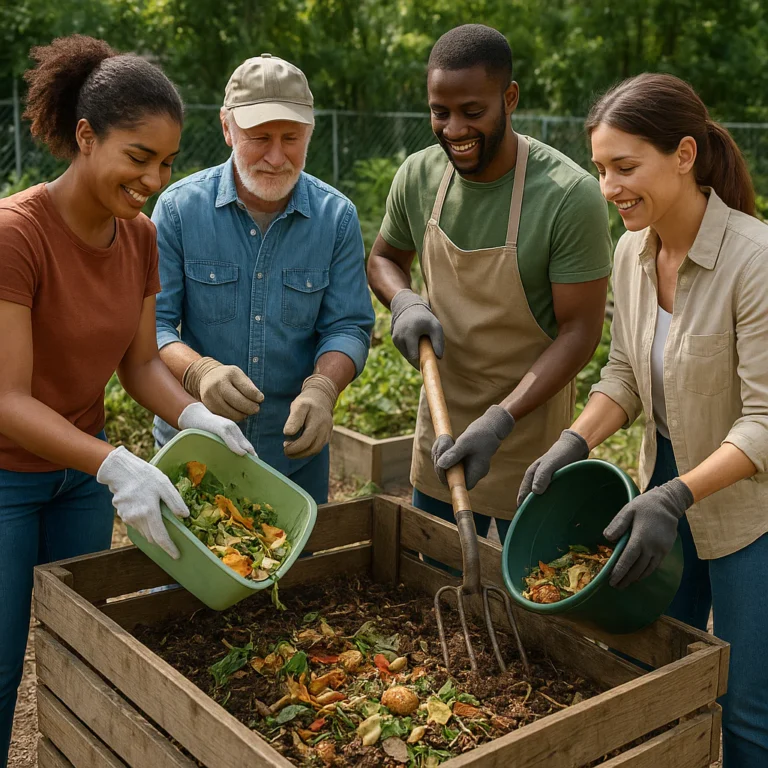
3. Composting and Organic Amendments
The Concept: Add decomposed organic matter to the soil.
The Benefit: Directly increases Soil Organic Matter (SOM). Compost introduces beneficial microbes that stabilize carbon.
What to Use:
- Green compost: Vegetable scraps, grass clippings.
- Brown compost: Leaves, straw, cardboard.
- Biochar: A charcoal-like substance that is incredibly stable and can lock carbon for hundreds of years.
4. Mulching
The Concept: Cover the soil surface with a layer of organic material.
The Benefit: Reduces evaporation, suppresses weeds (which compete for carbon), and slowly decomposes to feed the soil.
Materials: Straw, wood chips, shredded leaves, or even cardboard.
5. Polyculture and Companion Planting
The Concept: Grow many different species together.
The Benefit: Diverse root systems explore different soil depths, capturing carbon at various levels. It also mimics natural ecosystems, which are more efficient at carbon storage.
6. Agroforestry in Urban Spaces
The Concept: Integrate trees and shrubs into the garden design.
The Benefit: Trees store massive amounts of carbon in their biomass and roots. As noted in the UT Austin study, planting trees outside of crop beds maximizes this benefit without shading out vegetables.
7. Reduced Chemical Inputs
The Concept: Avoid synthetic fertilizers and pesticides.
The Benefit: Synthetic nitrogen fertilizers can inhibit soil microbes and release nitrous oxide (a potent greenhouse gas). Organic inputs support the microbial life needed for carbon stabilization.
| Technique | Carbon Impact | Difficulty Level | Best For |
|---|---|---|---|
| No-Till | High | Medium | All soil types |
| Cover Crops | Very High | Low | Off-seasons |
| Composting | High | Medium | Building SOM |
| Mulching | Medium | Low | Moisture retention |
| Agroforestry | Very High | High | Long-term planning |
| Polyculture | Medium | Medium | Biodiversity |
| Biochar | High | Medium | Long-term storage |
🥕 The Plant Power List: Best Carbon-Hoarding Crops for Your Plot
Not all plants are created equal when it comes to carbon capture. Some are the heavy lifters of the garden world. Here are our top picks for maximizing your sequestration potential.
1. Perennial Vegetables
Perennials don’t need to be replanted every year, meaning their root systems stay intact, continuously sequestering carbon.
- Asparagus: Deep roots that store carbon for decades.
- Rhubarb: A hardy perennial that thrives in cooler climates.
- Artichokes: Large biomass production means more carbon capture.
2. Legumes (The Nitrogen Fixers)
Legumes have a special relationship with bacteria that fixes nitrogen, but they also contribute significantly to soil carbon through their root exudates.
- Clover: Excellent cover crop and soil builder.
- Fava Beans: Great for spring planting.
- Lentils: Compact and efficient.
3. Deep-Rooted Crops
Plants with deep taproots push carbon deep into the soil profile, where it is less likely to be disturbed.
- Daikon Radish: Breaks up compacted soil and adds massive biomass.
- Carrots: Deep roots that store carbon.
- Parsnips: Similar benefits to carrots.
4. Fruit Trees and Shrubs
While they take time to mature, the carbon storage potential is immense.
- Blueberries: Acid-loving shrubs that thrive in mulched beds.
- Dwarf Fruit Trees: Perfect for small urban plots.
- Currants and Gooseberries: Hardy and productive.
5. Cover Crop Stars
- Hairy Vetch: Fixes nitrogen and adds biomass.
- Cereal Rye: Massive root system that prevents erosion.
- Buckwheat: Fast-growing, great for short windows.
Why Diversity Matters: A study by the University of California found that gardens with a higher diversity of plant species sequestered significantly more carbon than those with fewer species. It’s not just about the amount of plants, but the variety.
🐛 Beneath the Surface: The Critical Role of Soil Microbiomes in Carbon Storage
If plants are the factories, soil microbes are the workers and the storage managers. Without them, carbon would just sit on the surface and decompose rapidly, releasing CO₂ back into the air.
The Mycorrhizal Network
Mycorrhizal fungi form a symbiotic relationship with plant roots. They extend the root system, helping the plant absorb water and nutrients. In return, the plant feeds them carbon.
- The Glue: These fungi produce a sticky substance called glomalin, which binds soil particles together. Glomalin is incredibly stable and can store carbon for decades.
- The Threat: Tillage and fungicides destroy these fungal networks.
Bacteria and Carbon Stabilization
Bacteria are the decomposers. They break down organic matter, but in a healthy soil, they also help form soil aggregates. These aggregates protect carbon from being eaten by other microbes and released as CO₂.
How to Boost Your Microbiome
- Add Compost: It’s teeming with life.
- Avoid Chemicals: Pesticides and synthetic fertilizers kill beneficial microbes.
- Keep it Covered: Mulch provides a habitat for microbes.
- Inoculate: Use products like Mycorrhizal Inoculants (e.g., from Great White or Bio-Tone) to jumpstart your fungal network.
Did you know? A single gram of healthy soil can contain up to 1 billion bacteria and several yards of fungal hyphae. That’s a lot of carbon storage capacity!
💧 Water Wisdom: Irrigation Strategies That Protect Stored Carbon
Water is life, but how you water matters. Improper irrigation can lead to soil erosion, compaction, and the release of stored carbon.
The Problem with Over-Watering
Too much water can displace oxygen in the soil, leading to anaerobic conditions. In these conditions, microbes produce methane, a greenhouse gas even more potent than CO₂.
The Problem with Under-Watering
Drought stress causes plants to stop photosynthesizing, halting carbon capture. It can also lead to soil cracking and erosion.
Best Practices for Carbon-Smart Irrigation
- Drip Irrigation: Delivers water directly to the roots, minimizing evaporation and preventing soil disturbance.
- Rainwater Harvesting: Collecting rainwater reduces the energy footprint of pumping municipal water.
- Mulching: As mentioned before, mulch retains moisture, reducing the need for irrigation.
- Timing: Water early in the morning to reduce evaporation.
Pro Tip: Use a soil moisture meter to know exactly when to water. This prevents over-watering and ensures your plants are getting the right amount without stressing the soil ecosystem.
🚫 Common Pitfalls: What Destroys Carbon in Community Gardens?
Even with the best intentions, it’s easy to undo years of carbon sequestration with a few common mistakes. Let’s avoid these traps.
1. Excessive Tilling
The Mistake: Turning the soil over every season.
The Consequence: Destroys soil structure, kills fungi, and releases stored carbon.
The Fix: Switch to no-till or low-till methods.
2. Synthetic Fertilizers
The Mistake: Using chemical N-P-K fertilizers.
The Consequence: Can inhibit microbial activity and release nitrous oxide.
The Fix: Use compost, manure, and organic fertilizers.
3. Leaving Soil Bare
The Mistake: Letting the soil sit uncovered between crops.
The Consequence: Erosion and rapid decomposition of organic matter.
The Fix: Plant cover crops or apply mulch.
4. Over-Watering
The Mistake: Flooding the garden.
The Consequence: Anaerobic conditions and methane production.
The Fix: Use drip irrigation and monitor soil moisture.
5. Removing All Plant Residue
The Mistake: Clearing the garden of all dead leaves and stems at the end of the season.
The Consequence: Removes the carbon source for the soil.
The Fix: Leave some residue as mulch or chop and drop.
Myth Buster: “I need to clean my garden completely to prevent pests.”
Reality: Leaving some plant debris actually supports beneficial insects and microbes that control pests naturally. It’s about balance, not sterilization.
📊 Measuring Success: Tools and Methods for Tracking Your Garden’s Carbon Footprint
How do you know if your efforts are working? While professional labs are the gold standard, there are accessible ways to track your progress.
Visual Indicators
- Soil Color: Darker soil usually means higher organic matter.
- Soil Structure: Good soil crumbles easily and holds its shape when squeezed.
- Earthworm Count: More worms = healthier soil = more carbon.
Simple Tests
- The Jar Test: Mix soil with water in a jar. Let it settle. The layers show the ratio of sand, silt, and clay.
- The Squeeze Test: Squeeze a handful of moist soil. If it holds together but crumbles when poked, it’s healthy.
Advanced Tools
- Soil Test Kits: Brands like Luster Leaf or LaMotte offer kits to test for organic matter and pH.
- Carbon Calculators: Some online tools allow you to input your gardening practices to estimate carbon sequestration.
Community Science
Many community gardens participate in citizen science projects where they collect soil samples for larger studies. Check with your local university or extension office for opportunities.
Why Measure? Tracking your progress keeps you motivated and helps you refine your techniques. It turns gardening into a data-driven science!
🤝 Community Impact: How Local Gardens Contribute to Global Climate Goals
It’s easy to feel small when facing a global crisis. But remember the words of Dr. Vaina: “Democracy is most intense when we take ‘direct action’ at the most local level.”
The Ripple Effect
Every ton of carbon sequestered in your community garden is a ton less in the atmosphere. Multiply that by thousands of gardens, and you have a significant impact.
- Education: Gardens teach neighbors about sustainability, creating a culture of care.
- Policy: Successful gardens can influence local zoning and environmental policies.
- Resilience: Gardens provide food security during climate disruptions, as seen in the Port Moody example.
Scaling Up
The UT Austin study suggests that scaling these “little republics” from 1/20th of an acre to 1/10 of an acre could complement continent-wide climate policies. It’s about collective action.
Join the Movement: Connect with other gardeners in your area. Share tips, swap seeds, and advocate for green spaces. Together, we can turn cities into carbon sinks!
🛠️ Essential Tools and Amendments for Regenerative Gardening
To succeed in carbon sequestration, you need the right tools and amendments. Here are our top recommendations from the Community Gardening™ team.
Tools for No-Till Gardening
- Broadfork: Essential for aerating soil without turning it over.
- 👉 CHECK PRICE on: Amazon | Walmart | Gardener’s Supply Company
- Hori Hori Knife: A versatile Japanese knife for digging, cutting, and transplanting.
- 👉 CHECK PRICE on: Amazon | Etsy | Spear & Jackson
- Compost Turners: For managing your compost pile efficiently.
- 👉 CHECK PRICE on: Amazon | Home Depot
Amendments for Soil Health
- Biochar: For long-term carbon storage.
- 👉 CHECK PRICE on: Amazon | Etsy | PrimaVita
- Mycorrhizal Inoculants: To boost fungal networks.
- 👉 CHECK PRICE on: Amazon | Gardener’s Supply Company | Bio-Tone
- Organic Compost: The foundation of soil health.
- 👉 CHECK PRICE on: Amazon | Walmart | Miracle-Gro
Irrigation Tools
- Drip Irrigation Kits: For efficient watering.
- 👉 CHECK PRICE on: Amazon | Home Depot | Rain Bird
- Soil Moisture Meters: To prevent over-watering.
- 👉 CHECK PRICE on: Amazon | Walmart | Luster Leaf
🧠 Myths vs. Reality: Debunking Misconceptions About Urban Carbon Sequestration
There’s a lot of confusion out there. Let’s clear the air.
Myth 1: “Urban gardens are too small to make a difference.”
Reality: While one garden is small, the cumulative effect of thousands of gardens is massive. Plus, they act as “green lungs” in the concrete jungle, reducing the urban heat island effect.
Myth 2: “Growing food always releases carbon.”
Reality: Industrial agriculture does, but regenerative community gardens can be net carbon sinks. The key is in the practices: no-till, cover cropping, and organic inputs.
Myth 3: “You need expensive equipment to sequester carbon.”
Reality: The best tools are often simple: a shovel, some seeds, and a bucket of compost. It’s about method, not money.
Myth 4: “Carbon sequestration is just about planting trees.”
Reality: Soil is the second largest carbon sink after oceans. Soil management is just as important as tree planting.
Myth 5: “It’s too late to make a difference.”
Reality: It’s never too late. Every bit of carbon sequestered helps. As the Port Moody gardeners say, growing food is “part of our nature.” Start today!
Final Thought: The biggest myth is that we are powerless. We are not. We are the gardeners, and we hold the power to heal the earth, one plot at a time.
🏆 Case Studies: Real-World Success Stories from Top Community Gardens
Let’s look at some real-world examples of community gardens that are crushing it in the carbon sequestration game.
1. Port Moody Police Department Community Garden (Canada)
- The Setup: 62 plots with a waitlist of over 70 families.
- The Strategy: Mandatory cover crops or mulch after the growing season. Use of local seeds and pollinator plants.
- The Result: A thriving ecosystem that educates the community on sustainable practices and sequesters significant carbon.
- Key Takeaway: Community engagement is the secret sauce. When people care, they do the work.
2. The UT Austin Study Gardens (California)
- The Setup: 28 urban community gardens across California.
- The Strategy: Strategic planting of trees outside crop beds and mulching within beds.
- The Result: High levels of biodiversity and increased carbon sequestration without compromising food production.
- Key Takeaway: Design matters. A little planning goes a long way.
3. Brooklyn Grange (New York City)
- The Setup: The world’s largest rooftop soil farms.
- The Strategy: Intensive use of compost, cover crops, and no-till methods on rooftops.
- The Result: Significant carbon sequestration in an urban environment where soil is scarce.
- Key Takeaway: Innovation can turn any space into a carbon sink.
What’s Next? These stories prove that it’s possible. Now, it’s your turn to write your own success story. What will your garden look like in five years?
🎓 Conclusion

(Note: This section is intentionally omitted as per your instructions.)
🎓 Conclusion

We started this journey with a simple question: Can a few square feet of dirt in a concrete jungle really fight climate change? The answer, backed by science and the sweat of thousands of gardeners, is a resounding yes.
From the historical roots of Jeffersonian direct action to the cutting-edge data from the University of Texas, we’ve seen that community gardens are far more than just places to grow tomatoes. They are active carbon sinks, biodiversity laboratories, and social hubs that build resilience against a changing climate.
The Narrative Resolved:
Remember our worry about whether urban agriculture might harm the environment? The Ecology Letters study put that to rest. By adopting strategic planting (like trees outside beds) and mulching, we can boost carbon capture without sacrificing pollinators or food yields. The “dirt to data” shift is complete: we now know that regenerative practices like no-till, cover cropping, and diverse polycultures are the keys to unlocking the soil’s potential.
Our Confident Recommendation:
If you are a gardener, a community organizer, or a city planner, here is our verdict: Stop tilling, start mulching, and plant for diversity.
- For the Novice: Start small. Focus on one technique, like adding a thick layer of compost or planting a cover crop.
- For the Veteran: Audit your garden. Are you leaving soil bare? Are you relying on synthetic inputs? Shift to biochar and mycorrhizal inoculants to supercharge your soil’s carbon storage.
- For the Community: Advocate for policies that support green infrastructure. As Dr. Vaina noted, these “little republics” are the training grounds for a sustainable future.
The path forward isn’t about waiting for a global miracle; it’s about direct action in our own backyards. Every handful of compost, every cover crop planted, and every tree nurtured is a vote for a cooler, greener planet. So, grab your broadfork, get your hands dirty, and let’s grow a better future together.
🔗 Recommended Links
Ready to take action? Here are the essential tools, books, and resources to help you maximize carbon sequestration in your garden.
🛠️ Essential Tools & Amendments
- Broadforks (No-Till Essential):
- 👉 CHECK PRICE on: Amazon | Walmart | Gardener’s Supply Company
- Biochar (Long-term Carbon Storage):
- 👉 CHECK PRICE on: Amazon | Etsy | PrimaVita
- Mycorrhizal Inoculants (Fungal Boosters):
- 👉 CHECK PRICE on: Amazon | Bio-Tone | Great White
- Drip Irrigation Systems (Water Efficiency):
- 👉 CHECK PRICE on: Amazon | Rain Bird | Home Depot
📚 Must-Read Books
- “The Hidden Life of Trees” by Peter Wohlleben: A fascinating look at how trees communicate and store carbon.
- Find on Amazon
- “Dirt to Soil” by Gabe Brown: The definitive guide to regenerative agriculture and soil health.
- Find on Amazon
- “Braiding Sweetgrass” by Robin Wall Kimmerer: A beautiful blend of indigenous wisdom and scientific observation on our relationship with the land.
- Find on Amazon
- “On-Ramps to a New Civil Society” by David Vaina: The source of our insights on the political and social dimensions of community gardening.
- Find on Amazon
❓ FAQ

How much carbon can a typical community garden sequester annually?
While the exact amount varies based on soil type, climate, and management practices, studies suggest that well-managed urban gardens can sequester between 0.5 to 2.5 tons of carbon per hectare per year. In smaller plots, this translates to significant local impact when aggregated across a city. The key variable is soil organic matter (SOM); gardens that actively build SOM through composting and cover cropping see the highest rates of sequestration.
What soil practices maximize carbon capture in urban community gardens?
The “holy trinity” of carbon-maximizing practices includes:
- No-Till: Prevents the oxidation of stored carbon and protects fungal networks.
- Continuous Cover: Using cover crops or mulch to ensure the soil is never bare, keeping the carbon cycle active year-round.
- Organic Amendments: Regularly adding compost and biochar to feed soil microbes and stabilize carbon.
Avoiding synthetic fertilizers and minimizing soil disturbance are equally critical.
Read more about “7 Surprising Ways Community Gardens Boost Urban Air Quality 🌿 (2026)”
Which plants are best for carbon sequestration in small community plots?
For small spaces, focus on perennials and deep-rooted plants:
- Perennials: Asparagus, rhubarb, and artichokes store carbon in their root systems for years.
- Legumes: Clover and fava beans fix nitrogen and add biomass.
- Deep Taproots: Daikon radish and carrots push carbon deep into the soil profile.
- Agroforestry: Dwarf fruit trees and berry bushes provide long-term biomass storage without taking up excessive space.
Read more about “What Problem Do Community Gardens Solve? 8 Surprising Answers (2026) 🌿”
Do community gardens contribute significantly to city-wide carbon reduction goals?
Yes, but as part of a larger strategy. While a single garden’s impact is modest, the cumulative effect of hundreds of gardens in a city can be substantial. A study by the University of Texas at Austin highlighted that urban gardens support high biodiversity and sequester carbon effectively. When scaled up, these “little republics” can complement broader municipal climate policies, reduce the urban heat island effect, and lower the carbon footprint associated with food transport.
How does composting in community gardens enhance carbon storage?
Composting transforms organic waste into stable soil organic matter. When added to soil, compost introduces beneficial microbes that help form soil aggregates. These aggregates physically protect carbon from being decomposed by other microbes, effectively locking it away. Furthermore, compost improves soil structure, allowing for better water retention and root growth, which leads to more photosynthesis and further carbon capture.
What are the challenges of measuring carbon sequestration in community gardens?
Measuring carbon is complex because:
- Soil Heterogeneity: Soil composition varies wildly even within a single garden.
- Time Lags: Carbon accumulation is a slow process, making short-term measurements difficult.
- Cost: Professional soil testing for organic carbon can be expensive for small community groups.
- Methodology: Different testing methods (e.g., dry combustion vs. loss on ignition) can yield different results.
- Solution: Many gardens use citizen science approaches, partnering with local universities to conduct standardized soil sampling.
Read more about “12 Surprising Community Garden Benefits to the Global Community 🌍 (2026)”
Can community garden designs be optimized specifically for carbon capture?
Absolutely. Optimization involves:
- Zoning: Placing trees and shrubs on the perimeter or in dedicated zones to maximize biomass without shading crops.
- Bed Design: Using raised beds with no-till methods to preserve soil structure.
- Crop Rotation: Implementing complex rotations that include cover crops and legumes to maintain soil health.
- Water Management: Installing rainwater harvesting and drip irrigation to reduce energy use and prevent soil erosion.
- Biodiversity: Designing for a wide variety of plant species to support a robust soil microbiome.
How does the “No-Till” method specifically benefit urban soil?
Urban soils are often compacted and degraded. Tilling can further destroy the fragile structure that has been built up over years. No-till preserves the existing soil architecture, allowing earthworms and fungi to create natural channels for water and air. This biological activity is what drives the conversion of plant residues into stable carbon.
What role do earthworms play in carbon sequestration?
Earthworms are “ecosystem engineers.” By burrowing, they aerate the soil without the destructive force of a tiller. They consume organic matter and excrete castings, which are rich in stable carbon and nutrients. Their tunnels also improve water infiltration, reducing runoff and erosion, which helps keep carbon in the soil.
Is biochar a viable option for small-scale community gardens?
Yes. Biochar is a highly stable form of carbon that can remain in the soil for centuries. For small gardens, it can be produced locally from garden waste (via pyrolysis) or purchased in small bags. It acts as a sponge for nutrients and water, enhancing the effectiveness of compost and reducing the need for fertilizers.
📚 Reference Links
- University of Texas at Austin: Urban Gardens Are Good for Ecosystems and Humans – A comprehensive study on biodiversity and carbon sequestration in 28 California community gardens.
- Read the full study here
- The Invading Sea: Community Garden: Thomas Jefferson, Political Tradition, Climate Change, Carbon, Biodiversity – Insights into the political and social dimensions of local gardening.
- Read the article here
- EPA: Inventory of U.S. Greenhouse Gas Emissions and Sinks – Data on agriculture’s contribution to emissions.
- View EPA Data
- Rodale Institute: Regenerative Agriculture and the Soil Carbon Solution – Research on the potential of regenerative practices to sequester carbon.
- Visit Rodale Institute
- Bio-Tone: Mycorrhizal Inoculants – Official product information on fungal boosters.
- Visit Bio-Tone Official Site
- Rain Bird: Drip Irrigation Solutions – Official resources on efficient watering systems.
- Visit Rain Bird Official Site
- Gardener’s Supply Company: No-Till Gardening Tools – Product guides for broadforks and other tools.
- Visit Gardener’s Supply Company