Support our educational content for free when you purchase through links on our site. Learn more


The best community gardening and water conservation technologies start with healthy soil, mulch, and well-planned watering—not a complicated gadget. Add drip irrigation, rainwater storage, or moisture sensors where they solve a specific problem, and your garden can use water more thoughtfully without making volunteers babysit every bed.
We’ve seen a hose timer earn its keep in a shared garden, then watched a tiny leak quietly undo the good work. The lesson: efficient tools work best alongside simple habits—checking soil, inspecting lines, and agreeing on who waters when.
Key Takeaways
- Start with soil and routine: Build healthy soil, mulch bare beds, check moisture, and fix leaks before investing in new equipment.
- Match technology to the garden: Drip irrigation suits many beds; rain barrels capture roof runoff; timers and sensors help when schedules or site size make watering difficult.
- Plan for people as well as plants: Clear labels, shared watering schedules, and accessible controls help everyone use the system correctly.
- Treat savings claims as site-specific: Soil, weather, crops, installation, and maintenance all affect results—track your own water use to see what works.
- Check local rules and safety guidance: Rainwater and greywater use, backflow protection, and irrigation requirements vary by location.
Table of Contents
- ⚡️ Quick Tips and Facts
- 🌱 What Community Gardening and Water Conservation Mean
- 📚 How Community Gardens and Water-Smart Irrigation Evolved
- 💧 Why Water Conservation Matters in a Community Garden
- 🧭 Plan a Water-Wise Community Garden
- Assess sunlight, soil, slope, and water access
- Map garden beds, paths, and irrigation zones
- Set water-use goals and garden rules
- 🛠️ 12 Water Conservation Technologies for Community Gardens
- 1. Drip irrigation and soaker hoses
- 2. Smart irrigation controllers and timers
- 3. Soil-moisture sensors
- 4. Rain gauges and weather-based irrigation
- 5. Rain barrels and cisterns
- 6. Rain gardens and stormwater capture
- 7. Wicking beds and self-watering planters
- 8. Mulch and water-retentive ground covers
- 9. Compost and soil-building systems
- 10. Greywater reuse systems
- 11. Leak detectors and flow meters
- 12. Water-efficient taps, hoses, and nozzles
- ⚖️ Compare Garden Water-Saving Technologies
- Best options for small, shared, and school gardens
- Choosing between low-tech and smart irrigation
- 🔧 Install and Maintain a Community Garden Irrigation System
- Design irrigation zones for different crops
- Check water pressure, filters, and backflow prevention
- Seasonal maintenance and winterizing
- 🌦️ Watering Strategies for Crops, Seasons, and Drought
- When and how deeply to water
- Water needs for vegetables, fruit, herbs, and native plants
- Heat waves, drought restrictions, and emergency watering
- 🪴 Soil, Mulch, and Plant Choices That Reduce Water Use
- Build healthy, moisture-holding garden soil
- Choose drought-tolerant crops and climate-adapted varieties
- Use companion planting and shade strategically
- 🌧️ Rainwater Harvesting, Greywater, and Water Safety
- Calculate rainwater collection potential
- Keep stored water clean and mosquito-safe
- Understand local rules and safe greywater use
- 👥 Organize Gardeners Around Shared Water-Saving Habits
- Create watering schedules and volunteer roles
- Train members to spot leaks and stressed plants
- Make water conservation accessible and equitable
- 📊 Track Water Use and Measure What Works
- Set a baseline and monitor usage
- Measure harvests, soil moisture, and water savings
- 💰 Funding, Grants, and Partnerships for Water-Smart Gardens
- 🚫 Common Water Conservation Mistakes to Avoid
- 📣 Keep Your Community Growing and Learning
- ✅ Conclusion
- 🔗 Recommended Links
- ❓ FAQ
- 📖 Reference Links
⚡️ Quick Tips and Facts
Community gardening works best when good growing practices and good neighborly habits share the same plot. Our community gardening guide covers the broader setup; here, we’re focusing on the water-smart tools and routines that help shared gardens thrive.
At a glance
| Practice or technology | What it does | Best first step |
|---|---|---|
| Drip irrigation | Delivers water near plant roots | Group crops with similar water needs |
| Mulch and compost | Slow evaporation and improve soil structure | Add mature compost, then mulch the soil surface |
| Rain barrels or cisterns | Store roof runoff for later use | Check local rules and use a screened, covered tank |
| Soil-moisture checks | Prevent watering by habit alone | Check moisture several inches below the surface |
| Watering schedule | Keeps shared tasks predictable | Assign a named person for each watering day |
| Leak checks | Catch waste early | Inspect hoses, fittings, and emiters weekly |
✅ Start with the basics: repair leaks, water soil rather than foliage, mulch exposed beds, and give plants a deep drink when soil checks show they need it.
✅ Choose technology to solve a real problem. A timer won’t fix a poorly laid-out system; a rain barrel won’t help much if it overflows before the dry spell.
❌ Don’t assume every bed needs the same watering schedule. Seedlings, leafy greens, established tomatoes, and native perennials have different needs.
💧 A useful rule: Water deeply enough to wet the root zone, then check the soil before watering again. Local climate, soil texture, crop stage, and rainfall all matter.
UC Agriculture and Natural Resources recommends using mulch, efficient irrigation, and careful scheduling as part of water-wise gardening. Their California Garden Web water-conservation guidance also describes a community demonstration garden featuring rainwater collection and self-watering planters.
🌱 What Community Gardening and Water Conservation Mean
A community garden is more than a collection of plots: it’s a shared system of people, soil, plants, tools, and decisions. Water conservation means getting useful moisture to plants while reducing avoidable losses through evaporation, runoff, leaks, and overwatering.
In practice, it combines:
- Garden design: placing crops, paths, storage, and water access sensibly.
- Soil care: building structure and organic matter so water can infiltrate and remain available to roots.
- Efficient delivery: using drip lines, soaker hoses, olla pots, or carefully managed hand-watering.
- Shared routines: coordinating who waters, when, and how much.
- Measurement: checking soil and water use instead of relying on guesswork.
The U.S. Environmental Protection Agency’s WaterSense program emphasizes efficient water use across homes and landscapes. A community garden applies the same practical idea on a human scale: make every watering decision count, and make it easy for the next volunteer to do the same.
Why the “community” part changes the equation
One gardener may remember to close a tap. A shared garden may have dozens of people using it at different times. That’s why clear labels, simple schedules, and durable equipment matter as much as technical efficiency.
We’ve seen gardens invest in clever hardware, then lose water through an unnoticed split hose. The fix was not a more complicated controller. It was a weekly walk-through and a rule that the last person using a tap checks it before leaving.
Explore how gardens support connection, access to fresh food, and local resilience in our Benefits of Community Gardens articles.
📚 How Community Gardens and Water-Smart Irrigation Evolved
Gardeners have always adapted watering to local conditions. Traditional methods include hand-watering, furows, clay pots buried near crops, and capturing roof runoff. Modern systems add pressure regulators, filters, timers, sensors, and automated valves.
Neither “old” nor “new” automatically means better. A well-managed watering can may outperform a badly designed smart system. Conversely, a large community garden with many beds may save volunteer hours with zoned drip irrigation and reliable timers.
Ancient principles, modern tools
The basic principle behind targeted irrigation is simple: put water where roots can use it, at a rate the soil can absorb. The first video linked in the article, #featured-video, highlights buried unglazed clay pots, often called ollas, as a traditional way to release moisture slowly near roots. That’s a useful perspective, though claims about exact water savings should be treated cautiously: performance depends on pot size, soil, crop, climate, and how the garden is managed.
Modern drip systems apply a related idea with tubing and emiters. The technology changes; the root-zone logic does not.
Community gardens as demonstration sites
UC Master Gardeners describe a Water Conservation Garden and Educational Center developed with Pacific Oaks Community Garden. The project demonstrates rainwater collection, solar power, rain barrels, cisterns, and self-watering planters. It’s a good reminder that a garden can grow food and teach practical conservation at the same time.
💧 Why Water Conservation Matters in a Community Garden
Water is a shared resource, and inefficient watering can cost more than the utility bill. It can wash soil from beds, encourage disease, waste volunteer time, and leave some plots dry while others are soaked.
The garden-level benefits
| Benefit | What it can mean for your garden |
|---|---|
| Lower water waste | Less runoff, fewer leaks, and more moisture reaching roots |
| Healthier crops | More consistent moisture can reduce stress from repeated drying and soaking |
| Less labor | Timers and clear schedules reduce daily guesswork |
| Better soil | Compost and mulch support infiltration and moisture retention |
| Fairer access | Shared rules help prevent one bed from using most of the water |
| Greater resilience | Storage and efficient delivery help gardens prepare for dry spells |
There’s no universal percentage of water a garden will save with a particular product. Claims vary because soils, weather, crops, system design, and maintenance vary. Track your own water use and harvests rather than treating a manufacturer’s best-case figure as a promise.
Conservation is also about fairness
A shared garden may include older adults, busy caregivers, new gardeners, and people who cannot visit daily. A good system should reduce water waste without making garden access dependent one person’s availability. Ask plot holders what routines are realistic, then design around the group.
See our Community Garden Policies resources for help setting clear expectations.
🧭 Plan a Water-Wise Community Garden
Before buying irrigation equipment, walk the site after watering or rain. Look for puddles, dry corners, compacted paths, low spots, and places where water runs away from beds. Good planning often saves more water than adding gadgets later.
Assess sunlight, soil, slope, and water access
- Map sun and shade. Note which beds get full sun, afternoon heat, or shade from buildings and trees.
- Check soil texture. Sandy soil drains quickly; clay holds water longer but may absorb it slowly. Loam tends to offer a useful middle ground.
- Observe slope and runoff. Water moves downhill. Beds on a slope may need contouring, terracing, or slower irrigation.
- Locate taps and drainage. Record hose-bib locations, water meters, backflow devices, drains, and any rainwater storage.
- Test infiltration. Pour a measured amount of water onto a small area and note whether it soaks in or runs off. Repeat in more than one bed.
- Identify constraints. Check local water rules, landlord or municipal requirements, accessibility needs, and whether the site has reliable electricity or internet.
The USDA Natural Resources Conservation Service explains how healthy soil structure supports infiltration and water availability. For local recommendations, contact a cooperative extension office or soil and water conservation district.
Map garden beds, paths, and irrigation zones
Group plants by water need and growth stage, not simply by who owns the bed. A seedling nursery needs more frequent attention than established fruiting crops. Native flowers and drought-adapted perennials may need a different schedule from lettuces.
A basic layout should show:
- Water source and shutoff points
- Mainline and branch tubing
- Drip zones or hose routes
- Rain barrels or cisterns
- Compost and mulch storage
- Accessible paths and hose crossings
- Low spots where water collects
- Labels for valves, timers, and zones
Keep hoses off walking routes where possible. If they must cross a path, use a visible hose ramp or another approved trip-hazard solution.
Set water-use goals and garden rules
Agree on a few measurable goals, such as:
- Record meter readings monthly during the growing season.
- Inspect irrigation lines once a week.
- Water early in the day when practical.
- Report leaks immediately.
- Do not change shared timer settings without notifying the garden coordinator.
- Label rainwater as non-potable unless it has been treated and tested for its intended use.
Write the rules where gardeners actually see them: beside the tap, on the shed door, or in the garden’s communication channel.
🛠️ 12 Water Conservation Technologies for Community Gardens
No single tool fits every garden. A tiny school plot may need a hose timer and mulch. A large garden with dozens of beds may justify zones, pressure regulation, and a carefully maintained drip network.
1. Drip irrigation and soaker hoses
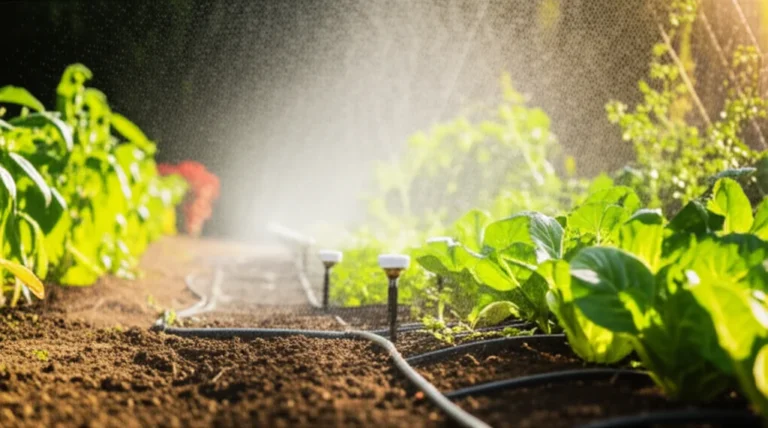
Drip irrigation uses tubing and emiters to deliver water near plant roots. Soaker hoses seep water along their length and can be useful in fairly straight, level beds.
Benefits
- Reduces water sprayed onto paths and foliage.
- Can be automated with a timer.
- Works well for rows, raised beds, and permanent planting layouts.
Drawbacks
- Emiters can clog without filtration or routine flushing.
- Poor layouts create dry spots or overwatered areas.
- Tubing can be damaged by tools, animals, sun, or careless mowing.
Use a filter and pressure regulator appropriate to the system. Check the manufacturer’s instructions; drip tubing is not one-size-fits-all. The University of Minnesota Extension offers practical vegetable-garden irrigation guidance.
Our field note: In one shared bed, the first drip layout looked tidy but left the far end thirsty. A quick catch-can test revealed uneven output. We shortened the run, added a branch line, and labeled the valve. Boring fix, excellent tomatoes.
2. Smart irrigation controllers and timers
A basic hose timer turns water on and off according to a schedule. A smart controller may adjust watering based on local weather, rainfall, or sensor input.
- Simple timers: easier to understand, often a good starting point.
- Weather-based controllers: may reduce watering after rain or during cooler conditions, but require correct setup.
- Wi-Fi systems: can be useful when a coordinator manages multiple zones, but internet access and account ownership matter.
Brands such as Orbit and Rachio offer irrigation controls. Compare compatibility with your tap, valve, pressure, and garden’s power or connectivity before buying.
✅ Choose a control system someone in the garden can maintain.
❌ Don’t set a timer once in spring and forget it through heat waves and rain.
3. Soil-moisture sensors
Sensors estimate moisture at a chosen depth. They can help prevent unnecessary watering, especially in large or frequently unattended gardens.
Best practice: place a sensor in representative soil near the active root zone, not in an unusually wet corner or directly beside an emitter. Check readings against a hand test. Sensors can fail, drift, or report misleading results when soil type and calibration are ignored.
Simple mechanical meters and electronic sensors can both help. They do not replace observation: a moisture reading does not tell you whether leaves are diseased, roots are shallow, or a valve is leaking.
4. Rain gauges and weather-based irrigation
A rain gauge gives the garden a local record of rainfall. Pair it with a watering log and you can avoid irrigating immediately after a useful shower.
- Place the gauge in an open area, away from roof edges and tree cover.
- Empty and record it consistently.
- Check the soil after rain; a short shower may wet the surface without reaching roots.
Weather-based irrigation tools can be helpful, but a forecast is not a soil measurement. Use both.
5. Rain barrels and cisterns
Rain barrels store roof runoff for later use; cisterns offer larger storage capacity. A rainwater system may need gutters, a leaf screen, a first-flush diverter, a screened inlet, an overflow route, and a stable base.
Benefits
- Captures water that might otherwise leave the site as runoff.
- Provides a backup source for hand-watering.
- Makes water conservation visible to gardeners and visitors.
Drawbacks
- Storage can be limited during long dry periods.
- Tanks need cleaning and mosquito protection.
- Stored water may not be suitable for every use, especially if roof materials or contamination are a concern.
The U.S. EPA’s rainwater harvesting resources explain collection basics. Check local rules before installation; requirements differ by location.
6. Rain gardens and stormwater capture
A rain garden is a planted depression designed to receive and infiltrate runoff. It is not simply a wet flower bed: site selection, soil drainage, overflow, and plant choice matter.
- Identify a safe source of runoff, such as a downspout or paved surface.
- Confirm that the site is away from foundations, septic systems, and utilities.
- Test drainage and check local stormwater guidance.
- Choose plants suited to alternating wet and dry conditions.
- Include a safe overflow route for heavy rain.
The EPA’s rain garden information explains how rain gardens can help manage stormwater. They may support habitat as well as water management, but are not a substitute for proper drainage engineering where flooding risks are serious.
7. Wicking beds and self-watering planters
Wicking beds use a water reservoir beneath the growing medium. Water moves upward by capillary action, helping keep the root zone consistently moist.
UC Master Gardeners’ Water Conservation Garden overview reports an average of 50% less water for self-watering planters in the context of that project. Treat this as a reported result, not a guaranteed saving for every garden: planter design, crop, weather, and comparison method all affect performance.
A well-built planter generally needs:
- A watertight reservoir
- An overflow outlet
- A fill tube
- A separator or support layer
- Suitable growing medium
- Access for cleaning and inspection
They can be useful for containers, patios, and gardeners who cannot water daily. They are less suitable for crops that prefer a dry root zone or for sites where standing water could create a safety or mosquito concern.
8. Mulch and water-retentive ground covers
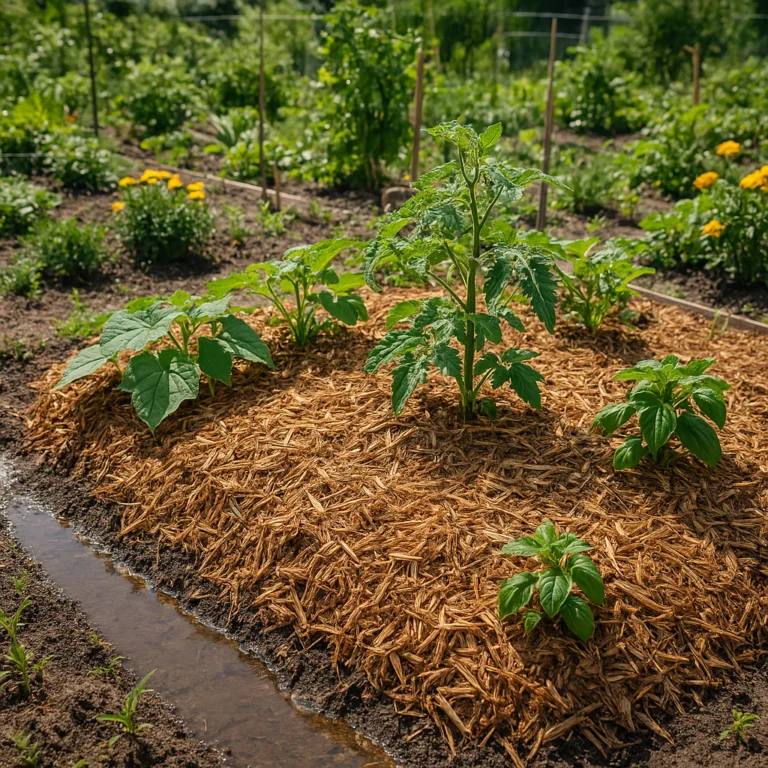
Mulch reduces direct soil exposure and can help limit evaporation and weeds. Depending on the crop and local conditions, options include clean straw, shredded leaves, wood chips for paths and perennial areas, or other locally suitable materials.
- Keep mulch away from stems to reduce rot and pest problems.
- Avoid material that may contain herbicide residues or contaminants.
- Refresh mulch as it decomposes or shifts.
- Use path mulch to reduce bare, dusty soil around beds.
The University of California Agriculture and Natural Resources and local extension services can provide region-specific guidance on suitable mulch materials.
9. Compost and soil-building systems
Compost improves soil structure and contributes organic matter. Denver Urban Gardens recommends adding compost as part of its water-conservation techniques, including a suggested approach of incorporating compost before planting and adding more through the growing season.
That advice is useful, but don’t treat a fixed amount as universal. Soil tests, existing organic matter, crop needs, and local compost quality should guide application. More compost is not always better; excessive additions can create nutrient imbalances or introduce salts, depending on the material.
A simple routine:
- Use finished, mature compost from a reliable source.
- Add it to the soil surface or incorporate it gently before planting.
- Avoid damaging established roots with deep cultivation.
- Cover bare soil with suitable mulch.
- Reassess soil condition each season.
10. Greywater reuse systems
Greywater generally means gently used water from sources such as bathroom sinks, showers, or laundry, depending on local definitions. It is not the same as untreated sewage, and rules vary widely.
Before using greywater in a community garden:
- Confirm local plumbing, public-health, and water regulations.
- Use only approved sources and systems.
- Avoid contact with edible portions of crops unless local guidance explicitly permits the practice.
- Keep greywater away from storm drains and neighboring properties.
- Use appropriate detergents and avoid products with harmful ingredients.
- Have the system designed and maintained by qualified professionals when required.
The U.S. EPA’s water reuse resources are a starting point, but your state or local health department is the authority for what is allowed.
11. Leak detectors and flow meters
A flow meter can reveal unusual water use; leak alerts can help identify a problem before it becomes a sogy mystery. A garden can also use a simple manual meter-reading log.
Look for:
- Unexpected flow while all zones are off
- A sudden increase in monthly use
- Wet soil near a valve or buried line
- A barrel that empties unusually quickly
- Low pressure at the end of a line
A sensor is helpful only if someone responds to alerts. Assign responsibility, document shutoff locations, and keep the relevant contact details near the irrigation controls.
12. Water-efficient taps, hoses, and nozzles
A shutoff nozzle helps prevent water from running while someone walks between beds. A kink-resistant hose can be easier to manage, while a watering wand can deliver a gentle stream to seedlings and containers.
Choose equipment that:
- Fits the garden’s tap and pressure.
- Can be repaired or replaced with common fittings.
- Has clear shutoff controls.
- Is easy for gardeners with different strength and mobility levels to use.
A hose nozzle is a small tool, not a complete irrigation plan. Still, a reliable shutoff is one of the easiest ways to stop “I’ll be right back” from becoming a puddle.
⚖️ Compare Garden Water-Saving Technologies
| Technology | Installation effort | Best fit | Main limitation |
|---|---|---|---|
| Mulch and compost | Low | Nearly all beds | Must be refreshed and sourced safely |
| Soaker hose | Low to moderate | Straight, level beds | Can water unevenly over long runs |
| Drip irrigation | Moderate | Rows and raised beds | Needs filtration, layout, and maintenance |
| Hose timer | Low | Small or simple gardens | Schedule still needs seasonal adjustment |
| Smart controller | Moderate | Multiple zones or frequent absences | Setup and connectivity can complicate use |
| Soil-moisture sensor | Low to moderate | Beds where overwatering is common | Needs correct placement and interpretation |
| Rain barrel | Moderate | Gardens with suitable roof runoff | Storage can run out; local rules apply |
| Cistern | Moderate to high | Larger sites and organized groups | Higher design and maintenance demands |
| Wicking planter | Moderate | Containers and small spaces | Limited capacity and crop suitability |
| Rain garden | High | Runoff-management areas | Requires suitable site and drainage planning |
| Olla | Low to moderate | Individual plants or compact beds | Requires refilling and careful placement |
Best options for small, shared, and school gardens
- Small garden: mulch, a shutoff nozzle, a watering log, and a few olla pots or self-watering containers.
- Raised-bed garden: drip tubing with a filter, pressure regulator, timer, and labeled zones.
- School garden: simple, visible systems students can understand, plus an adult assigned to check them.
- Large community site: zone-based irrigation, flow monitoring, storage where feasible, and documented maintenance.
- Drought-prone location: prioritize soil cover, efficient delivery, crop selection, and a realistic water-use plan before expanding storage.
If the garden has a limited budget, spend attention before spending money: map water needs, fix leaks, and build a shared schedule. Hardware works best when the human system works too.
Choosing between low-tech and smart irrigation
Ask four questions:
- Who will maintain it? If the answer is unclear, choose the simplest reliable option.
- How many zones are there? More zones can justify a controller.
- Is the water supply predictable? Storage and sensors are more valuable when supply is uncertain.
- Can the group troubleshoot it? Keep instructions and contact details on-site.
A basic timer may be all a small garden needs. A smart controller may be worthwhile when one coordinator needs to manage many zones or adjust watering remotely. Automation is not conservation by itself; the system must be set correctly and checked.
🔧 Install and Maintain a Community Garden Irrigation System
Design irrigation zones for different crops
Divide the garden into zones based on:
- Plant water needs
- Soil type and slope
- Sun exposure
- Bed size and crop stage
- Irrigation method
- Available pressure and flow
Keep young seedlings and thirsty vegetables separate from established perennials when possible. That way, watering one group doesn’t soak another.
Step-by-step installation checklist
- Draw the layout. Mark the source, valves, mainline, branches, and emiters.
- Check system compatibility. Confirm tubing size, pressure range, filter requirements, and fittings.
- Install a backflow-prevention device if required. Follow local plumbing codes and water-provider guidance.
- Flush lines before attaching emiters. This helps remove grit that can clog outlets.
- Secure tubing without trapping it under paths or sharp edges.
- Run each zone and inspect for leaks.
- Use catch cups or measured containers to compare output at different points.
- Label every valve and timer setting.
- Teach at least two people how to shut the system off and restart it.
Check water pressure, filters, and backflow prevention
Low pressure can leave the end of a line dry. Excessive pressure can cause leaks or irregular emitter performance. Filters protect small outlets from particles; pressure regulators help keep flow within equipment specifications.
Backflow prevention protects the drinking-water supply from contamination. Requirements depend on the connection and local code, so ask the water provider or a licensed professional rather than guessing.
Seasonal maintenance and winterizing
Weekly during the growing season
- Walk the lines while water is running.
- Check for leaks, blocked emiters, and dry patches.
- Confirm that timers match current weather and crop needs.
Monthly
- Clean filters according to manufacturer instructions.
- Review meter readings or water logs.
- Check rain barrels, screens, overflows, and lids.
At season’s end
- Drain hoses and exposed lines where freezing is possible.
- Remove or protect timers and sensors according to manufacturer guidance.
- Clean and store reusable equipment.
- Record what failed, what worked, and what should be repaired before spring.
🌦️ Watering Strategies for Crops, Seasons, and Drought
When and how deeply to water
Water early in the day when practical. Cooler conditions can reduce losses from evaporation, and foliage has time to dry. The Denver Urban Gardens guide advises watering during cooler hours and focusing water at soil level. That’s a useful general practice, not a strict rule that overrides local disease guidance or a garden’s schedule.
Use this sequence:
- Check soil moisture several inches down, near the active root zone.
- Water slowly so the soil can absorb it.
- Pause if water begins running off.
- Check how deeply moisture reached.
- Wait until the root zone needs water again.
The right depth depends on crop and soil. Seedlings need more frequent, gentle attention because their roots are shallow; established plants usually benefit from deeper watering with longer intervals.
Water needs for vegetables, fruit, herbs, and native plants
| Plant group | General approach | Watch for |
|---|---|---|
| Seedlings | Keep the root zone evenly moist, not saturated | Drying surface and poor establishment |
| Leafy greens | Consistent moisture helps avoid stress | Wilting and rapid bolting in heat |
| Fruiting vegetables | Deep, steady moisture after establishment | Blossom-end rot can be linked to irregular water availability |
| Herbs | Match water to species; many Mediterranean herbs prefer drainage | Overwatering and root problems |
| Fruit trees and berries | Water broadly across the root zone, not only at the trunk | Shallow watering and competition from weeds |
| Native plants | Water during establishment, then follow local species guidance | Assuming all natives need no water immediately |
For crop-specific growing advice, browse our Edible Plants resources.
Heat waves, drought restrictions, and emergency watering
During heat or restrictions:
- Prioritize newly planted crops and plants in establishment.
- Use mulch to shade soil.
- Avoid fertilizing stressed plants unless local guidance recommends it.
- Harvest mature crops promptly to reduce plant load.
- Check local watering rules and communicate them to all members.
- Keep a written priority list for limited supplies.
Climate-adapted planning can help gardens prepare for changing weather. See our Climate Adaptation in Gardening category for related strategies.
🪴 Soil, Mulch, and Plant Choices That Reduce Water Use
Build healthy, moisture-holding garden soil
Healthy soil is not a sponge you can keep adding amendments to indefinitely. It is a living system whose structure, organic matter, drainage, and nutrient balance all affect water use.
Denver Urban Gardens calls compost-enriched soil “one of the best water conservation techniques available to gardeners” in its water-conservation article. The useful takeaway is that improving soil can support moisture retention and root growth; the specific amendment rate should still fit your soil.
Practical soil routine
- Test soil before making major amendments.
- Use mature compost from a trustworthy source.
- Avoid working wet soil, which can damage its structure.
- Keep soil covered with plants or mulch where practical.
- Reduce unnecessary digging around established roots.
- Remove weeds before they compete with crops.
Choose drought-tolerant crops and climate-adapted varieties
A “drought-tolerant” label does not mean a plant needs no water. It means the plant may cope better with dry periods once established, under suitable conditions.
Look for:
- Varieties recommended by local extension services.
- Crops suited to your growing season.
- Plants that mature before the hottest part of the year.
- Perennials and native plants suited to local rainfall patterns.
- Seed sources that disclose climate and adaptation information.
Ask experienced local gardeners what survives a dry summer with less intervention. Their observations are useful, especially when paired with extension guidance and seed-trial data.
Use companion planting and shade strategically
Shade cloth, trellising, and thoughtful bed placement can reduce heat stress for crops that struggle intense sun. But shade can also reduce yields for sun-loving crops, so plan it deliberately.
- Use temporary shade for heat-sensitive crops during extreme conditions.
- Place tall crops where they won’t block light from shorter neighbors.
- Use trellises to improve airflow and make irrigation access easier.
- Avoid dense planting that traps moisture and increases disease pressure.
🌧️ Rainwater Harvesting, Greywater, and Water Safety
Calculate rainwater collection potential
A rough estimate of roof runoff is:
Rainfall depth × roof catchment area × collection efficiency
The precise conversion depends on units and system losses. For a practical estimate, use a local rainwater calculator from a university extension, water utility, or government agency, then account for first-flush diversion, leaks, overflow, and dry-season demand.
Before investing, ask:
- How much rain falls in a typical month?
- How large is the roof area?
- Can gutters safely direct runoff to storage?
- How much water can the garden realistically store?
- Where will overflow go during heavy rain?
Keep stored water clean and mosquito-safe
- Cover tanks securely.
- Screen inlets and overflows.
- Keep gutters clear.
- Inspect for leaks and stagnant water.
- Prevent children or visitors from accessing unsafe openings.
- Label water storage clearly.
- Follow local public-health recommendations.
Stored rainwater is generally non-potable unless treated and tested for the intended use. Never assume it is safe to drink because it looks clear.
Understand local rules and safe greywater use
Rainwater harvesting, cross-conections, and greywater reuse are regulated differently across jurisdictions. Ask your local water provider, building department, or public-health authority before installing a system. For greywater, follow approved designs and safeguards; improvised plumbing can contaminate drinking-water systems or create a public-health problem.
👥 Organize Gardeners Around Shared Water-Saving Habits
Create watering schedules and volunteer roles
A watering calendar works when it is simple and visible. Include:
- Who is responsible for each day or zone
- How to check soil before watering
- Which beds receive priority during restrictions
- Where shutoff valves are located
- Who to contact about leaks
- How to record unusual weather or equipment issues
Rotate duties so the same volunteer does not become the garden’s unofficial full-time irrigation department.
Find opportunities for hands-on learning and group work in our Community Garden Events section.
Train members to spot leaks and stressed plants
Teach gardeners to notice:
- Water running from a line or fitting
- A wet patch where no plants are growing
- Dry soil despite an active irrigation cycle
- Wilting that does not improve after appropriate watering
- Unusual leaf discoloration or fungal symptoms
- A sudden change in water-meter readings
A short seasonal demonstration can prevent months of confusion. Show volunteers how to close the valve, clean a filter, identify a blocked emitter, and report a problem without blaming the last person who touched the timer. We’re growing vegetables, not a courtroom drama. 🌿
Make water conservation accessible and equitable
Choose controls that are easy to reach, read, and operate. Use large labels, plain-language instructions, and more than one way to report a problem. Consider gardeners who cannot lift heavy hoses, visit every day, or use smartphone-only controls.
Shared technology should reduce barriers, not create new ones. A manual shutoff and printed instructions are valuable backups even when the garden uses a smart controller.
📊 Track Water Use and Measure What Works
Set a baseline and monitor usage
Before changing the irrigation system, record a baseline where possible:
- Meter reading and date
- Number of irrigated beds
- Rainfall and unusual heat
- System run times
- Major leaks or repairs
- Crop types and planting dates
After changes, compare similar periods if you can. One rainy month compared with a hot, dry month is not a fair test.
[Measure harvests, soil moisture, and water savings](#measure-h harvests-soil-moisture-and-water-savings)
A useful garden dashboard can track:
| Measure | Simple method |
|---|---|
| Water use | Meter readings or tank-volume logs |
| Soil moisture | Consistent hand test or sensor readings |
| Crop performance | Harvest weight or count by bed |
| Irrigation reliability | Weekly inspection checklist |
| Volunteer effort | Hours spent watering and repairs |
| Weather | Rainfall and major heat events |
Water use per harvest can be a helpful comparison, but don’t let one metric decide everything. A community garden also provides learning, social connection, food access, and habitat. Track what matters to your group, then use the results to adjust the plan.
💰 Funding, Grants, and Partnerships for Water-Smart Gardens
Potential partners include municipal water utilities, extension offices, local nonprofits, garden clubs, schools, community foundations, and soil and water conservation districts. Ask about:
- Irrigation audits or technical assistance
- Rain barrel or compost programs
- Conservation education materials
- Cost-share opportunities
- Volunteer training
- Equipment donations
- Demonstration-garden partnerships
The Highlands Soil and Water Conservation District invites landowners in its service area to discuss technical assistance and cost-share opportunities. Its material is aimed at landowners broadly, not specifically at community gardens, so contact the district directly to ask whether a particular program fits your site.
For local event and workshop ideas, check our Community Garden Events listings.
🚫 Common Water Conservation Mistakes to Avoid
❌ Watering by calendar alone. Weather and soil conditions change. Check the root zone.
❌ Installing drip irrigation without testing it. A tidy layout can still water unevenly.
❌ Treating rain barrels as an unlimited supply. Storage may run dry when the garden needs water most.
❌ Using untreated greywater without checking the rules. Local requirements and public-health safeguards matter.
❌ Piling mulch against stems. Keep it back enough to avoid rot and pest issues.
❌ Applying compost by a fixed recipe without considering the soil. Test and adjust.
❌ Automating the system and forgetting it. Timers need seasonal changes, inspections, and a human backup.
❌ Assuming every plant should get the same amount of water. Crop type, age, soil, and exposure all affect needs.
❌ Leaving responsibility vague. “Someone will check it” often means nobody does.
❌ Overpromising water savings. Product claims and demonstration results are context-dependent. Measure your own garden.
📣 Keep Your Community Growing and Learning
The most durable water-saving technology is the one your community understands and keeps working. Start with an irrigation walk-through, a soil-and-mulch workday, or a demonstration of rain gauges and drip lines. Let gardeners compare notes across beds; the person growing beans beside the fence may have spotted the site’s most persistent dry patch.
Try a simple seasonal learning plan:
- Spring: map water access and inspect equipment.
- Early summer: teach soil-moisture checks and mulching.
- Peak heat: review water schedules and restrictions.
- Fall: assess system performance and record lessons.
- Winter: plan repairs, funding, and crop changes.
Share what worked, what failed, and what surprised you. That’s how a garden turns a handful of water-saving devices into a culture of conservation.