Support our educational content for free when you purchase through links on our site. Learn more

Community gardening and local seed sovereignty start with a simple practice: grow a few suitable crops, save their seed responsibly, and share the knowledge and decisions with your community. You don’t need a farm or a room full of seed jars. A balcony tomato, a shared bean bed, or a library seed box can help build a more connected local seed network.
One northern community seed project began with a harvest small enough to fill a biscuit tin. That modest start grew into workshops, seed exchanges, and relationships among local growers—a reminder that seed sovereignty is built season by season, not all at once.
Key Takeaways
- Start small: Choose one or two open-pollinated crops suited to your space and climate.
- Save seed carefully: Manage pollination, label seed lots clearly, dry them thoroughly, and test germination.
- Make access fair: Share seed and skills without requiring every participant to donate or already know how to garden.
- Respect people and place: Seek consent and follow community guidance when growing or sharing culturally significant seeds.
- Build a network, not just a seed box: Connect gardeners, libraries, schools, food projects, and local growers.
- Grow resilience together: Secure land, preserve biodiversity, and keep decisions about local seeds in community hands.
Table of Contents
- ⚡️ Quick Tips and Facts
- 🌱 What Are Community Gardening and Local Seed Sovereignty?
- Community gardening, seed saving, and seed sovereignty explained
- How seed sovereignty differs from seed security
- 📜 How Community Seed Sovereignty Took Root
- Indigenous seed stewardship and living cultural heritage
- The modern seed system, seed laws, and local responses
- 🌍 Why Local Seed Sovereignty Matters
- Biodiversity, resilient crops, and climate adaptation
- Food justice, access, and community wellbeing
- Local food systems and shorter seed supply chains
- 🏡 How Community Gardens Build Seed Sovereignty
- Choosing a garden site and setting shared goals
- Making space for seed crops in a small garden
- Creating an inclusive, community-led seed project
- 🌾 How to Start a Community Seed-Saving Project
- Find members, partners, and local growing knowledge
- Choose crops suited to your climate and community
- Plan seed crops, growing space, and a seasonal calendar
- Set up shared records and clear stewardship agreements
- 🥕 Seed-Saving Basics for Community Gardeners
- Open-pollinated, heirloom, and hybrid seeds explained
- Self-pollinating and cross-pollinating crops
- Isolation distances, hand pollination, and preventing cross-pollination
- Harvesting, cleaning, drying, and storing seeds
- Testing germination and keeping seed records
- 📚 Community Seed Libraries, Exchanges, and Seed Banks
- How to start a seed library
- Planning a welcoming seed swap
- Labelling, storage, donations, and lending guidelines
- Seed banks, living collections, and community access
- 🗺️ UK Community Seed Sovereignty in Action
- Jackie and Squash CIC: local seed growing in Liverpool
- Jamie and Sow Northern: community seeds in Norton
- Jennifer and UN_EARTH: growing local seed knowledge in Westerdale
- Nathan and Cultivate Tes Valley: community growing in Stockton-on-Tes
- Charlie Gray: Seeds of Hope and Horton Community Farm in Bradford
- Daphne Du Cros: Little Woodbatch and Shropshire’s good food network
- Emma Cardwell and Warren Draper: seed learning from Lancaster to Doncaster
- Mark Ridsdill-Smith: urban seed saving and Vertical Veg in Newcastle
- Nell Catchpole: sound, storytelling, and seed culture in Tesside
- Dennis Touliatos: the Lancaster Seed Library
- 🤝 Indigenous Knowledge, Seed Rights, and Ethical Seed Sharing
- Respecting cultural ownership and community consent
- Avoiding biopiracy and extractive seed collecting
- Sharing seed stories with permission and proper attribution
- ⚖️ Seed Laws, Plant Variety Rights, and Practical Rules
- Seed exchange and sales rules in the UK
- Plant breeders’ rights, patents, and seed labels
- Biosecurity, invasive plants, and disease prevention
- 🌦️ Common Challenges and How Communities Can Solve Them
- Limited space, time, and volunteer capacity
- Poor germination, crop failure, and seed contamination
- Funding, land access, and long-term project resilience
- Making seed projects accessible and representative
- 🧰 Tools, Supplies, and Useful Garden Resources
- Seed envelopes, jars, labels, and storage equipment
- Recommended books, courses, and seed-saving guides
- Finding local growers, seed networks, and funding
- ✅ Quick Tips for a Stronger Local Seed Network
- 🌱 Conclusion
- 🔗 Recommended Links
- ❓ FAQ
- What does seed sovereignty mean in a community garden?
- Can beginners save seeds successfully?
- Which vegetables are easiest to save seeds from?
- Can a community garden save seeds from hybrid plants?
- How do we stop different varieties from cross-pollinating?
- How long do saved seeds last?
- Are community seed swaps legal in the UK?
- How can a small garden contribute to local seed sovereignty?
- 📖 Reference Links
⚡️ Quick Tips and Facts
Community gardening and local seed sovereignty go beyond growing vegetables: they help communities decide what to grow, preserve locally adapted varieties, and share the skills and relationships that keep seeds alive. For a primer on community gardening, start with a simple shared plot, a few reliable crops, and a clear agreement about who will care for the plants and seeds.
| Quick fact | What it means for your garden |
|---|---|
| Seed saving starts with the right crop. | Tomatoes, peas, lettuce, and beans are approachable choices for new seed savers. |
| Not every seed grows true to type. | Seeds saved from hybrid plants may produce offspring that vary; open-pollinated varieties are usually better for maintaining a consistent variety. |
| Pollination matters. | Crops that cross-pollinate may need distance, timing, barriers, or hand pollination to maintain varietal identity. |
| A seed library needs more than seed packets. | Good labels, storage, records, clear access rules, and volunteers make it useful and dependable. |
| Land access is part of seed sovereignty. | Seeds need space, time, water, and community members able to grow them. |
| Small spaces can contribute. | Container gardeners can save seed from suitable self-pollinating crops such as tomatoes and peas. |
Our quick-start checklist
- ✅ Choose one or two open-pollinated crops that grow well locally.
- ✅ Ask experienced gardeners which varieties thrive in your neighborhood.
- ✅ Label each plant and seed lot with its variety, source, harvest date, and grower.
- ✅ Save seed from healthy, vigorous plants, not merely the first plant to produce.
- ✅ Dry seed thoroughly and store it cool, dry, and clearly labelled.
- ✅ Share seed with context: include growing notes and any known pollination concerns.
- ❌ Don’t promise that every saved seed will grow true to type.
- ❌ Don’t treat culturally significant seeds as anonymous collectibles; ask before sharing and follow community protocols.
For practical crop ideas, browse our guides to edible plants and climate adaptation in gardening. One question will guide everything that follows: who gets to decide what happens to the seed?
🌱 What Are Community Gardening and Local Seed Sovereignty?
Community gardening brings people together to grow food, flowers, and community knowledge. Seed sovereignty is the ability and responsibility of communities to shape how seeds are selected, saved, shared, and cared for. A garden may grow plenty of food yet have little seed sovereignty if it depends entirely on purchased seed and has no say over what is planted or how seed is shared.
That doesn’t mean every garden must produce all its own seed. A resilient project can combine purchased seed, seed-library access, local seed saving, and relationships with trusted growers. The aim is greater community choice and stewardship, not seed self-sufficiency at any cost.
Community gardening, seed saving, and seed sovereignty explained
- Community gardening: a shared growing space where people cooperate to grow plants and manage land.
- Seed saving: collecting and storing seed for future planting.
- Local seed sovereignty: community influence over seed access, use, knowledge, and continuity, grounded in local conditions and values.
- Food sovereignty: the broader right of people and communities to shape their food systems, including decisions about land, production, and food culture.
A seed packet is a beginning, not a complete system. Seed sovereignty also depends on land access, gardening skills, time, water, storage, cultural knowledge, and fair decision-making.
How seed sovereignty differs from seed security
These ideas overlap, but they’re not identical. Seed security generally concerns whether people can access enough suitable seed when they need it. Seed sovereignty asks who controls that access and whether communities can exercise their rights and responsibilities around seed.
| Question | Seed security | Seed sovereignty |
|---|---|---|
| Is seed available for planting? | Central concern | Important, but not the whole picture |
| Who decides which varieties are available? | May be suppliers, institutions, or growers | Communities should have meaningful influence |
| Are seeds saved and shared locally? | Helpful for access | Often central to collective stewardship |
| Are cultural relationships and rights considered? | May not be addressed | Essential where seeds carry cultural meaning |
| Is land available to grow seed? | A practical need | A foundation of community control |
The FAO’s work on plant genetic resources and the UN Declaration on the Rights of Indigenous Peoples help explain why seed access, biodiversity, and community rights can’t be reduced to a packet count.
📜 How Community Seed Sovereignty Took Root
Seed keeping is much older than the modern community garden movement. Across cultures, people have selected, grown, stored, and exchanged seed as part of food production and cultural life. Community seed libraries and urban seed projects are contemporary expressions of that long history, not its starting point.
Indigenous seed stewardship and living cultural heritage
For many Indigenous communities, seeds are not simply agricultural inputs. They may be relatives, ancestors, teachers, and responsibilities. In Elizabeth Hoover’s research on Native American farming and gardening, seeds are described as “intergenerational relatives”—both children who need care and elders whose wisdom deserves respect. Her Harvard talk on seed sovereignty and “Our Living Relatives” explores these relationships and the work of Indigenous seed keepers.
This perspective asks gardeners to think beyond “saving a rare variety.” Who is its community of origin? Who has permission to share it? What responsibilities come with growing it? Where seed has been separated from its people, returning it may be a matter of relationship and consent, not simply shipping a packet.
The modern seed system, seed laws, and local responses
Modern seed systems include commercial breeding, public research, seed companies, community exchanges, and seed banks. Each can contribute useful varieties and knowledge; each also has different priorities and rules.
Community efforts often respond to practical gaps: seed that is locally adapted may be hard to find, access can be expensive or inconvenient, and useful growing knowledge can disappear when older gardeners leave. In northern England, projects featured in Northern Seed Stories have paired seed libraries with workshops, markets, farms, allotments, and community events.
Those projects show that seed sovereignty is built through relationships and repeated practice. A seed swap is lively; a season-long network of growers, records, and shared responsibility is what makes the seed supply dependable.
🌍 Why Local Seed Sovereignty Matters
Local seed stewardship can support biodiversity, food skills, community connection, and adaptation to local growing conditions. It is not a magic shield against climate change or food insecurity, but it can give communities more options and strengthen their ability to respond.
Our gardeners see the strongest projects connect seed work to wider benefits of community gardens: people meet, learn, cook, exchange knowledge, and build shared ownership of a place.
Biodiversity, resilient crops, and climate adaptation
Growing and saving a range of varieties helps maintain crop diversity. A locally grown variety may perform well under the conditions a community faces, but “local” doesn’t automatically mean climate-proof. Observe results over several seasons, keep records, and share failures as well as successes.
The FAO’s State of the World’s Biodiversity for Food and Agriculture describes the importance of biodiversity to food and agriculture. For gardeners, the practical message is straightforward: diversity creates options. A garden with several crops and varieties is less dependent one plant thriving every year.
Try a small, documented trial:
- Select varieties suited to your site and growing season.
- Record sowing dates, weather, pest pressure, and harvest.
- Compare performance rather than relying on memory.
- Keep seed only from healthy plants that meet your community’s goals.
- Share results at a work party, seed swap, or other community garden event.
Food justice, access, and community wellbeing
Seed sovereignty connects to questions of who can obtain land, seed, tools, water, and time. A free packet is of little use to someone without a place to plant it; a thriving garden can still exclude people if its hours, language, layout, or rules create barriers.
The USDA reports that Black farmers owned 14% of U.S. farmland in 1910, followed by a dramatic decline in Black land ownership over the following decades. That history is part of the broader context for land justice and food sovereignty; see the USDA’s historical overview of Black farmers. In the video perspective summarized for this article, Sunlight Gardens in Battle Creek, Michigan, is described as linking food access with youth training and a community “Farmacy.” It also makes a useful distinction: urban agriculture excels at neighborhood access and programming, while rural farms can supply the larger volumes needed by institutions.
Gardens can support wellbeing, connection, and cultural continuity, but they are not a substitute for public investment, secure land, or fair food systems. Pair practical gardening with advocacy and partnerships, rather than asking volunteers to solve structural problems alone.
Local food systems and shorter seed supply chains
Local seed networks can shorten the distance between growers and seed, making it easier to share practical information and adapt planting choices. A gardener who knows where a packet came from can ask about the parent plants, growing conditions, and seed quality.
That doesn’t make all local seed better than commercial seed. A reputable supplier may offer strong selection, clear variety descriptions, and high germination. Community-grown seed adds something different: local relationships, shared learning, and direct participation.
🏡 How Community Gardens Build Seed Sovereignty
A garden can turn seed sovereignty from an abstract phrase into a shared routine: sow, observe, select, harvest, label, store, and share. The key is to give the seed work a real place in the garden plan rather than relying one enthusiastic person to remember everything.
Choosing a garden site and setting shared goals
Start with the realities of the site: land tenure, sunlight, water access, soil safety, storage, and who can reach it. If a community plot is on temporary land, prioritize portable tools and seed crops that fit the remaining growing time. See our community garden policies for ideas on transparent shared rules.
Before sowing, agree on a few questions:
- Are we growing seed mainly for local exchange, education, food production, or maintaining specific varieties?
- Who can take seed, and how will we make access fair?
- How will we handle varieties with cultural significance?
- What happens if a key volunteer leaves?
- Where will seed records and supplies live?
Written answers need not be a legal novel. A page of clear, community-approved principles is far more useful than a binder nobody opens.
Making space for seed crops in a small garden
Seed crops often need to stay in the garden longer than food crops. A leafy vegetable may be ready to eat before it is ready to flower and set seed. Some plants also need more space, more time, or distance from another variety.
| Garden space | Seed-saving possibilities | Planning note |
|---|---|---|
| Balcony or containers | Tomatoes, peas, some lettuces | Choose compatible varieties and keep labels secure |
| Small shared bed | Bush beans, peas, lettuce | Avoid planting multiple cross-pollinating varieties together without a plan |
| Larger allotment | Squash, brassicas, beans, peas | Plan isolation and account for nearby gardens |
| Community farm | Larger seed crops and trials | Coordinate growers, records, cleaning, and storage |
For a small-space seed saver, Mark Ridsdill-Smith of Vertical Veg recommends starting with crops such as tomatoes and peas, and also highlights chillies, lettuce, and French beans. Container growing can make seed work accessible, but it does not remove the need to understand pollination.
Creating an inclusive, community-led seed project
A robust seed project welcomes people with different levels of experience. Make it easy to join without asking newcomers to already know the difference between a seed pod and a seed head.
- Offer hands-on tasks: labelling, watering, seed cleaning, and packet making.
- Use clear signs and accessible language; translate materials where possible.
- Provide options for people who can’t attend every week.
- Recognize knowledge held by elders, migrants, disabled growers, and experienced home gardeners.
- Agree how cultural knowledge and seed stories may be recorded or shared.
- Build partnerships with libraries, schools, food projects, and local growers.
A seed event can be joyful and informal. The work behind it—access, consent, records, follow-up—should be just as welcoming. More ideas for inclusive gatherings are in our community garden events collection.
🌾 How to Start a Community Seed-Saving Project
Begin small enough that the project can survive a wet summer, a volunteer moving away, and the disappearance of the one person who owns the only marker pen. A first-year project with two well-documented crops beats a grand plan with thirty unlabeled jars.
Find members, partners, and local growing knowledge
Invite gardeners, allotment holders, seed savers, libraries, schools, food groups, and local farms. Ask each partner what they can offer and what they need. A library may provide a welcoming collection point; an allotment society may know which crops thrive locally; a food project may help make seed access more equitable.
Use a short first meeting to agree on:
- The purpose of the project.
- Who it is for and how people can join.
- Which crops to grow and why.
- Where seed, records, and tools will be kept.
- How the group will handle cultural protocols and legal requirements.
Choose crops suited to your climate and community
Start with crops that are familiar, useful, and manageable in your growing season. Ask gardeners what they already grow and what they would be excited to share.
Good beginner candidates include tomatoes, peas, lettuce, and French beans, provided the variety and pollination situation suit the site. Each has a different harvest and processing routine; choose one you can reliably finish rather than several you can only half-complete.
Check seed descriptions and growing guidance from reputable sources such as the Royal Horticultural Society’s seed-saving advice and Garden Organic.
Plan seed crops, growing space, and a seasonal calendar
Seed production takes longer than harvesting vegetables for the kitchen. Build the calendar around the full crop cycle.
| Stage | What to do | Record |
|---|---|---|
| Planning | Choose variety, site, and pollination strategy | Seed source, variety, intended use |
| Sowing | Label rows, pots, or trays immediately | Date, batch, grower |
| Growing | Select healthy, representative plants | Growth, pests, weather, flowering |
| Flowering | Protect variety identity if needed | Nearby compatible varieties, pollinators |
| Seed set | Allow seed to mature on the plant | Harvest readiness and plant health |
| Harvest | Collect mature seed in suitable weather | Date, quantity, condition |
| Cleaning and drying | Remove debris and dry fully | Method, drying notes |
| Storage | Seal and label seed lots | Location, germination test date |
Use a shared calendar and assign a backup person for each task. Weather does not care that your main seed steward is away that weekend.
Set up shared records and clear stewardship agreements
A seed record can be simple, as long as it is consistent. Include:
- Common and variety name, if known
- Seed source and date received
- Grower or plot location
- Sowing and harvest dates
- Pollination notes
- Cleaning and drying method
- Germination test results
- Any restrictions or cultural protocols for sharing
Agree that no one changes a label based on memory alone. If a variety is uncertain, write “identity uncertain” instead of inventing a confident name. Accuracy is a kindness to the next grower.
🥕 Seed-Saving Basics for Community Gardeners
The details vary by crop, but the broad sequence is the same: grow the right plant, let seed mature, harvest at the right time, clean it, dry it, label it, and store it well. The part that catches new seed savers most often is not harvesting. It’s pollination.
Open-pollinated, heirloom, and hybrid seeds explained
| Term | Meaning | Seed-saving implication |
|---|---|---|
| Open-pollinated | A variety that can reproduce reliably through natural or managed pollination when kept appropriately isolated | Usually suitable for saving if pollination is controlled and plants are selected thoughtfully |
| Heirloom | A commonly used term for older, traditionally maintained varieties; definitions vary | Often open-pollinated, but verify the variety and its history |
| Hybrid (F1) | The first generation from a cross between selected parent lines | Saved offspring may be variable and may not match the parent plant |
| Local or community-selected variety | A population maintained or adapted through ongoing local growing and selection | Records and shared stewardship help maintain its identity |
The RHS explains that seed saved from hybrids may not reproduce consistently in its seed-saving guidance. That does not make hybrid seed useless. Hybrids can be productive and valuable for growing food; they’re simply a less dependable choice when your goal is to maintain a stable variety from saved seed.
Self-pollinating and cross-pollinating crops
Plants can self-pollinate, cross-pollinate, or do both. The crop and variety determine the best approach.
- Often easier for beginners: tomatoes, peas, lettuce, and French beans, depending on variety and local pollination.
- More planning required: squash, maize, brassicas, and other crops that readily cross-pollinate with compatible varieties.
The phrase “self-pollinating” does not mean “impossible to cross.” Pollinators and nearby varieties can still affect some crops. Use crop-specific guidance from the RHS and Seed Savers Exchange, and consider what other gardens are growing nearby.
Isolation distances, hand pollination, and preventing cross-pollination
Isolation can be achieved in several ways. Distance is one tool, but it is not always practical in a community garden with neighboring plots.
- Grow one variety of a crop species. This is often the simplest approach.
- Separate varieties by distance. Check crop-specific recommendations; there is no universal distance that fits every species or landscape.
- Stagger flowering times. Varieties that flower at different times are less likely to cross, though timing can shift with weather.
- Use physical barriers. Mesh or cages can limit pollen movement, but pollination may need to be managed.
- Hand-pollinate where appropriate. This requires identifying flowers and timing the process correctly.
- Record nearby crops. A neighbor’s plot can affect seed purity; talk with them before flowering.
Isolation distances in seed-saving references vary because they depend on crop species, pollinator behavior, terrain, and the level of varietal purity needed. Trust crop-specific guidance, not a single all-purpose number.
Harvesting, cleaning, drying, and storing seeds
Harvest mature seed on a dry day when possible. Some crops need wet processing, while others are simply threshed or shaken from dry seed heads. Follow a crop-specific method, and keep each variety separate throughout.
Drying and storage basics
- Remove chaff, damaged seed, and plant debris.
- Dry seed thoroughly before sealing it. Damp seed in a closed container can spoil.
- Use paper packets for short-term drying and labelled airtight containers for fully dry seed.
- Store in a cool, dark, dry place.
- Keep seed away from heat, sunlight, pests, and household moisture.
- Never mix a new seed lot into an old jar without recording the change.
A Sper Scientific moisture meter or a home seed-drying setup is not essential for every community garden, but careful observation and consistent storage are. For larger projects, a dedicated dry storage area and sealed containers can make quality control much easier.
Testing germination and keeping seed records
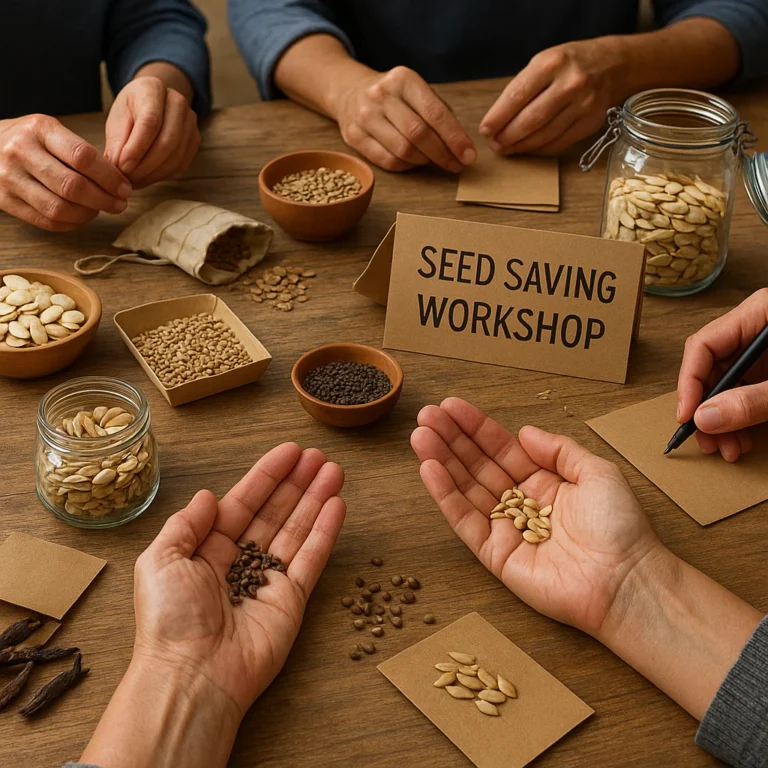
A simple germination test helps prevent disappointment. Place a known number of seeds between damp paper towels, keep them in suitable conditions, and count how many sprout over the crop’s normal germination period.
For example, if 8 out of 10 seeds sprout, the test result is 80% germination. Record the number tested, the date, and conditions. A small test is a guide, not a guarantee; seed lots can vary.
Use seed-testing guidance from the University of Minnesota Extension and follow the relevant crop’s temperature and timing requirements. Then label packets with the test date and result so recipients can decide how thickly to sow.
📚 Community Seed Libraries, Exchanges, and Seed Banks
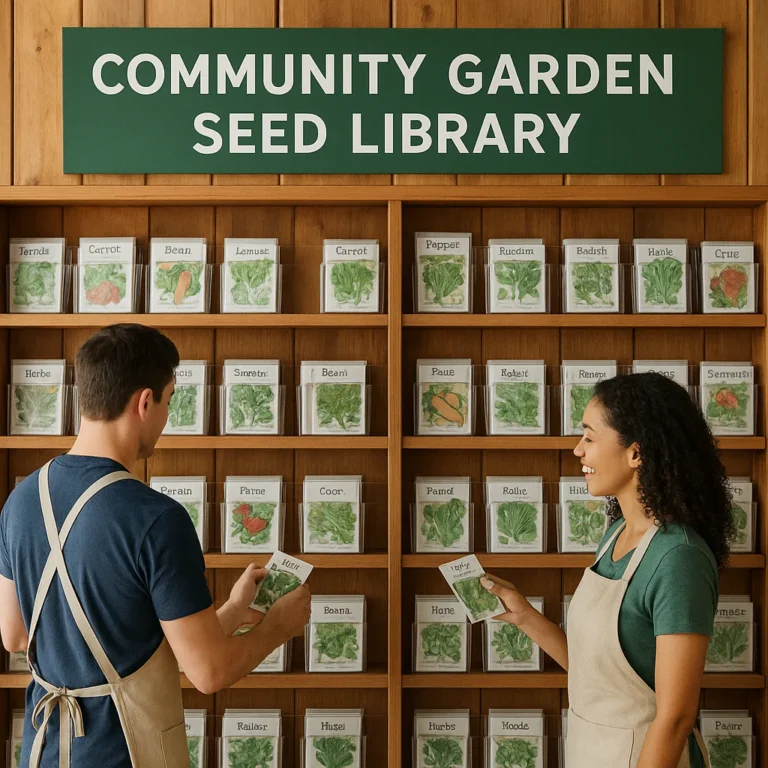
A seed library shares seed with the public, often through a library, community garden, or local organization. A seed bank may focus more on long-term conservation, collections, and record-keeping. A seed swap is usually a gathering where people exchange seed and growing knowledge. These models can overlap; what matters is that the group is clear about its purpose.
How to start a seed library
Keep the first collection manageable. Choose a host, establish a simple catalog, and decide how participants can access seed.
- Start with a small set of clearly labelled varieties.
- Explain how to grow and save each one.
- Record the source, variety name, and any relevant growing notes.
- Decide whether people borrow seed, receive seed, return seed, or simply share when they can.
- Make access welcoming to people who have no seed to donate.
- Review local legal requirements before distributing or selling seed.
The Lancaster Seed Library combines seed-growing at Claver Hill with seed cabinets, “Sew and Sow Boxes,” practical training, and seasonal events. That mix matters: a cabinet makes seed visible; a living growing site builds the skills and supply behind it.
Planning a welcoming seed swap
A good seed swap is less “bring a packet or stay out” and more “come learn, share, and leave with something useful.” Include growers who are new to seed saving and people who cannot bring seed.
A simple event plan:
- Choose a convenient, accessible venue.
- Provide a short welcome and clear seed-sharing guidelines.
- Label seed with crop, variety, source, and harvest year when known.
- Separate uncertain or unlabeled seed from verified varieties.
- Offer a demonstration or table for questions.
- Give newcomers seed and a growing guide without requiring a donation.
- Record common questions and follow up with participants.
Northern seed projects often pair swaps with workshops and community gatherings. Browse our community garden events for more ways to make a seed event part of a broader growing calendar.
Labelling, storage, donations, and lending guidelines
Be transparent about what the seed is and what is known. A useful packet label includes the variety, crop, source, harvest year, and any germination result. If identity or pollination history is uncertain, say so.
A seed library’s written policy can cover:
- Whether donated seed is accepted year-round
- How seed is screened and labelled
- Whether members are expected to return seed
- How culturally significant varieties are handled
- What happens when seed is old or poorly documented
- Whether the library distributes commercial seed as well as locally saved seed
Avoid making “return seed” a requirement that blocks access. Many gardeners are learning, and a crop failure is not a moral failing. Provide seed freely or through a flexible model, then invite people to contribute when they can.
Seed banks, living collections, and community access
A community seed bank can conserve varieties while keeping them available for growing. Storage alone, however, is not enough: seed viability declines, varieties need renewal, and knowledge can be lost if nobody grows them.
A living collection grows its seed in real gardens. This brings practical benefits:
- People can observe plant traits and growing habits.
- Seed quality and adaptation can be evaluated.
- Knowledge stays connected to people and place.
- Members can develop confidence through hands-on work.
Shropshire’s planned rural seed-bank network, as described in Northern Seed Stories, aims to train seed stewards and support local seed banks. The model highlights a useful principle: distributed stewardship can make a network less dependent one site or one volunteer.
🗺️ UK Community Seed Sovereignty in Action
Northern England’s seed projects show that there is no single template. Some work through seed libraries, others through mobile swaps, farms, urban growing spaces, or creative events. Their common thread is that seed becomes part of everyday community life.
The examples below are drawn from Northern Seed Stories. They are not a scorecard. Each project responds to its own people, land, resources, and growing conditions.
Jackie and Squash CIC: local seed growing in Liverpool
In Toxteth, Squash CIC began the Toxteth Seed Library in 2013 after a workshop with the Heritage Seed Library. Volunteers grew seed at three Windsor Street sites; the first harvest was, in Jackie’s words, “just enough to fill a biscuit tin.”
That tiny harvest became a useful beginning. The project now connects gardens, growers, and allotment holders through annual seed-saving and sharing events, with seed also available at the Squash Shop by donation. Weekly gardening and cooking sessions bring people together around practical work and shared meals.
The lesson for a new project: start with what you can grow, then build a culture around it. Jackie’s hope is that people can grow, save, and share seed “no matter how much space they have available to them.” That includes a balcony pot, not just a plot.
Jamie and Sow Northern: community seeds in Norton
Sow Northern uses a mobile seed-library box and a regular swap stall at Norton Green Market in Stockton. The mobile approach carries seed to people instead of expecting everyone to find their way to a permanent garden or library.
The group’s Potato Day also distributes seed potatoes at wholesale cost, and it aims to share seedlings with local schools. Jamie describes seed sharing as a way to introduce people to varieties they may not know and help those who might otherwise lack access.
A mobile library has a practical advantage: it can join existing markets and community events. It also needs careful labels, stock records, and a reliable person to manage it. Mobility improves reach; organisation keeps the box useful.
Jennifer and UN_EARTH: growing local seed knowledge in Westerdale
UN_EARTH, working across the Tes–Esk region, links seed trials with questions about social inequality, agroecology, land use, and urban–rural relationships. Trials included carlin peas and field beans, crops with both culinary and cultural relevance in northern England.
The project illustrates why seed growing can be a form of local research. A trial asks not only “will it grow?” but also:
- Who has access to the land and harvest?
- Does the crop fit local food traditions?
- Can small growers clean and process it?
- What does the crop contribute to a resilient local food system?
That broader lens helps prevent seed trials from becoming a hobby detached from community needs.
Nathan and Cultivate Tes Valley: community growing in Stockton-on-Tes
Cultivate Tes Valley CIC turns underused urban land into community food-growing spaces. At Arlington Park, volunteers took part in the Cultivate Kale Project, from sowing and tending plants to harvesting and processing seed.
The project began after an accidental cross between a Purple Tree Collard and an unnamed ornamental kale. Its F2 offspring varied; some showed perennial traits, and cutings were multiplied for further evaluation. Future F3 seed and workshops could let local growers explore small-scale plant breeding.
This is a valuable teaching example, but it needs careful labelling: an experimental cross is not yet a stable named variety. Record its parentage and generation clearly. The project’s shared space with Sprouts Community Food Charity, the Amal Project, and Corner House Youth Project also shows how seed work can connect to cooking, food access, and community support.
Charlie Gray: Seeds of Hope and Horton Community Farm in Bradford
Bradford’s Seeds of Hope Seed Library, launched in 2021, attracted 60 members. The group has been developing its administration, seed-steward team, and plans for a more permanent home. A local library has agreed to host seeds and explore connections with the wider library service.
A “pay it forward” membership option lets one person support another’s participation. That kind of design recognizes a basic truth: equal access does not always mean identical contributions. Some people can donate money, some seed, some time, and some knowledge.
The library’s next challenge—tracking seed and building durable systems—is familiar to community projects. Shared records and a clear home for the collection matter just as much as a good launch.
Daphne Du Cros: Little Woodbatch and Shropshire’s good food network
At Little Woodbatch in rural Shropshire, open-pollinated vegetable seed supports the volunteer-run Bishop’s Castle Community Seed Bank. Seed is distributed through a monthly farmers’ market and partnerships with a food bank and library.
The planned Rural Seed Bank Network under the Shropshire Good Food Partnership aims to train seed stewards, build local seed banks, and improve access to open-pollinated varieties. It also connects seed saving to climate resilience and food-system shocks.
For rural areas, a network can help with scale: one grower may maintain seed, another may host events, and a library or food project may support distribution. The seed travels through relationships, not just post.
Emma Cardwell and Warren Draper: seed learning from Lancaster to Doncaster
At Bentley Urban Farm in Doncaster, Warren Draper connects seed, land, culture, and community through an agroecological approach. The project occupies one acre on land once part of Bentley Commons. Its central message is plain: seds need somewhere—and someone—to plant them.
The Northern Seed Stories account contrasts community seed practices in Chiapas with severe historical declines in U.S. seed-variety availability. Such comparisons are useful prompts, but figures from different regions and studies should not be treated as directly comparable without checking their original methods and definitions. The dependable takeaway is that seed diversity and land access can be lost through economic and political change.
In Lancaster, Emma Cardwell and the Lancaster Seed Library connect a growing site at Claver Hill with seed cabinets, Sew and Sow Boxes, training, a potato day, and a seed swap. Volunteers gather for practical work, including seed cleaning and packing. The project has also explored a polytunnel to increase production.
Both examples underline the same point: a seed network requires land, volunteers, learning, and a shared purpose. A packet without those supports is a promise with nowhere to grow.
Mark Ridsdill-Smith: urban seed saving and Vertical Veg in Newcastle
Mark Ridsdill-Smith’s Vertical Veg supports container growing on balconies, yards, and other small urban spaces. He recommends focusing on crops such as tomatoes and peas, which can be more manageable for small-scale seed saving, along with chillies, lettuce, and French beans.
Mark also saves orache and nasturtium seed for microgreens. That’s a useful reminder that the value of saving seed is not limited to staple crops; it can also bring unusual or costly-to-source varieties into local circulation.
A container garden can still teach observation, selection, and seed care. It simply needs a crop suited to the space—and a realistic understanding of whether pollination can be controlled.
Nell Catchpole: sound, storytelling, and seed culture in Tesside
Sound artist Nell Catchpole recorded people handling and shaking beans at a northern seed gathering. The recordings captured seed histories, growing challenges, and local microclimates. She describes art as a way to “amplify the sounds and voices that wouldn’t otherwise get heard.”
Creative work can make a technical topic feel human. A bean seed has a texture, a sound, a story, and a grower behind it. Art will not replace germination tests or good storage, but it can help a project invite more people into the conversation.
Dennis Touliatos: the Lancaster Seed Library
Dennis Touliatos and the Lancaster Seed Library describe a community model built through practical sessions, seed-growing, swaps, and partnerships. The project uses training and periodic gatherings to help participants learn seed saving, then brings people together for winter cleaning and packing.
The work depends on trust and volunteers, and its challenges are candid: sustaining participation across a whole season, producing seed of suitable quality, and agreeing on the project’s purpose. Those are not signs of failure; they are the real work of building a movement.
Dennis’s chosen seed to take anywhere is Black Emperor runner beans. A specific variety can carry memory and enthusiasm; a good seed library makes room for that personal connection while keeping the practical growing information attached.
🤝 Indigenous Knowledge, Seed Rights, and Ethical Seed Sharing
Seed sovereignty can’t be separated from the rights, histories, and priorities of the people who have stewarded seeds. Community gardeners should be careful not to treat Indigenous seeds or knowledge as open-access material simply because they are available online or held in an institution.
Elizabeth Hoover’s work emphasizes that Indigenous seed stewardship can involve cultural responsibility, community-defined rights, and the return of seeds to their communities of origin. The Native American Food Sovereignty Alliance offers a starting point for learning about Indigenous food sovereignty and community-led work.
Respecting cultural ownership and community consent
Before growing, naming, displaying, or distributing culturally significant seed, ask:
- Who is the community of origin?
- Has the seed been shared with permission?
- Are there conditions on growing, documenting, or distributing it?
- Who should be consulted before public storytelling?
- Would returning or rematriating seed be more appropriate than using it?
Consent is ongoing. Permission to grow seed does not automatically mean permission to sell it, publish a story about it, or share it with another organization.
Avoiding biopiracy and extractive seed collecting
Biopiracy generally refers to the appropriation or commercial use of biological resources and associated knowledge without appropriate consent or benefit-sharing. A community project can avoid extractive behavior by being transparent about sources, following community guidance, and refusing to claim ownership of seed or knowledge it did not create.
- Don’t relabel a culturally important variety as your own discovery.
- Don’t collect seed or stories from a community without asking.
- Don’t assume online availability means unrestricted use.
- Don’t commercialize shared seed without clear agreement.
- Do support community-led conservation and seed-return efforts.
Sharing seed stories with permission and proper attribution
A seed story can be personal, sacred, or politically sensitive. Ask how the grower or community wants it attributed, and offer the chance to review text before publication.
If the story concerns an Indigenous community, work with appropriate representatives rather than relying on a third party to speak for them. Atribution is not a substitute for consent, but respectful attribution is still part of responsible storytelling.
⚖️ Seed Laws, Plant Variety Rights, and Practical Rules
Seed exchange rules differ by country and can depend on whether seed is exchanged informally, offered publicly, sold, or marketed as a particular variety. Check current rules before distributing seed beyond a small local exchange. UK requirements may be affected by variety registration, marketing, plant health, and post-Brexit changes.
For current UK guidance, consult the GOV.UK plant variety and seed marketing pages and the Animal and Plant Health Agency. This is practical orientation, not legal advice.
Seed exchange and sales rules in the UK
A private, informal exchange among gardeners may be treated differently from seed marketed to the public. Once a project sells seed or distributes it widely, additional rules may apply. Before running a public-facing seed library, ask the relevant authority what requirements apply to the specific crop and activity.
Keep a record of:
- Whether seed is donated, exchanged, or sold
- Where it was sourced
- Whether it is listed as a named variety
- Any plant health or quality information
- How the seed is labelled and distributed
Do not assume that a nonprofit or community purpose automatically exempts a project from regulation.
Plant breeders’ rights, patents, and seed labels
Plant breeders’ rights and patents can affect how protected varieties are propagated, sold, or used. The details depend on the variety and jurisdiction. Check the UK Intellectual Property Office’s plant varieties guidance before multiplying or distributing a protected variety commercially.
For seed packets, make distinctions clear:
- Known open-pollinated variety: label accurately and keep source records.
- Hybrid or protected variety: follow relevant terms and restrictions.
- Uncertain identity: say so plainly.
- Experimental cross: record parentage and generation; don’t present it as stable without evidence.
Biosecurity, invasive plants, and disease prevention
Community sharing should not spread pests, diseases, or invasive plants. Use clean seed, keep it dry, remove plant debris, and follow any restrictions on seed movement. Avoid sharing seed from diseased plants unless a specialist has confirmed it is safe.
Check current advice from UK Plant Health Information and the Royal Horticultural Society. When in doubt, pause distribution and ask an appropriate plant-health specialist.
🌦️ Common Challenges and How Communities Can Solve Them
Seed projects run on seasonal rhythms, while volunteer availability, funding, and land access can change at any time. A realistic plan makes room for missed harvests and imperfect seed. A crop failure is information, not proof that the community is bad at gardening.
Limited space, time, and volunteer capacity
Choose fewer crops and share tasks. A crop lead can coordinate the plan, but several people should know how to label, harvest, clean, and store seed.
- Use compact, suitable crops for small spaces.
- Combine individual plots with a shared seed bed.
- Make tasks short and clearly posted.
- Schedule seed work around existing community events.
- Keep a backup person for critical tasks.
- Partner with gardens, libraries, schools, and allotments.
Poor germination, crop failure, and seed contamination
Start troubleshooting with records. Was seed immature, damp during storage, old, or exposed to heat? Did the variety cross-pollinate? Was it sown at the wrong depth or temperature?
A useful review asks:
- What was the weather and growing condition?
- Were plants healthy and typical of the variety?
- Was pollination managed appropriately?
- Was seed fully mature and dry before storage?
- Did the germination test match the sowing result?
- What should change next season?
Don’t quietly mix questionable seed into the main collection. Label it as unverified, test it, and share it only with accurate information.
Funding, land access, and long-term project resilience
Land tenure is a core part of seed sovereignty. A project with no secure growing site may preserve seed for a while, but it cannot plan confidently for long-term seed production. Ask landowners for written agreements, and keep essential records and equipment portable where possible.
Funding can support seed trays, storage, training, interpretation, accessibility, and paid coordination. Do not build a plan that depends forever on unpaid labor from a handful of people. The video perspective summarized for this article makes the wider point: healthy agricultural systems need policy, education, land use, and equitable access, not just enthusiastic gardeners.
Making seed projects accessible and representative
Look at who is missing from the garden and ask why. Bariers may include inaccessible paths, inconvenient hours, language, transport, childcare, cost, or a lack of trust.
Make participation flexible:
- Offer seed without requiring a donation.
- Use accessible venues and plain-language instructions.
- Share leadership and decision-making.
- Welcome food traditions and growing practices from diverse communities.
- Compensate skilled facilitators when funding permits.
- Ask communities how they want their knowledge represented.
🧰 Tools, Supplies, and Useful Garden Resources
Most beginner seed projects need fewer gadgets than they think. Start with sturdy labels, envelopes, clean containers, a notebook, and somewhere dry to work. Buy specialist equipment only when the project’s scale or crop mix warrants it.
Seed envelopes, jars, labels, and storage equipment
| Supply | Useful for | What to look for |
|---|---|---|
| Paper seed envelopes | Drying and small seed lots | Writable surface and secure closure |
| Glass jars or airtight containers | Fully dry seed storage | Clean, dry, and clearly labelled |
| Waterproof labels | Garden rows and containers | Ink that stays legible outdoors |
| Sieves and trays | Separating seed from chaff | Sizes appropriate to the seed |
| Screens or drying racks | Air-drying seed | Good airflow and protection from pests |
| Notebook or digital spreadsheet | Records and inventory | Shared access and regular backups |
| Hand lens | Inspecting seed and plant health | Comfortable magnification |
Brands such as Dymo make label printers, while Ball jars can be reused for dry storage. These are options, not requirements; clean reused containers and durable handwritten labels work perfectly well.
Recommended books, courses, and seed-saving guides
- The Complete Guide to Saving Seeds by Robert Gough and Cheryl Moore-Gough — a practical reference covering many crops.
- Seed to Seed by Suzanne Ashworth — a widely used crop-by-crop seed-saving guide.
- RHS seed-saving advice — accessible guidance for home gardeners.
- Garden Organic seed-saving resources — practical support for growing and saving seed.
- Seed Savers Exchange learning resources — guides and educational material on seed saving.
Use books to build confidence, then verify crop-specific details against the growing conditions and rules where you live.
Finding local growers, seed networks, and funding
Look for nearby seed libraries, allotment associations, community-supported agriculture groups, heritage seed organizations, food partnerships, and public libraries. In the UK, the Seed Sovereignty Programme connects projects and learning, while Garden Organic offers gardening resources.
For funding and partnerships, search local council community grants, charitable foundations, climate-action funds, and food-partnership networks. A modest, well-documented pilot—with a clear purpose, community partners, and plans for access—is often easier to support than an ambitious project with no proven volunteer base.
The video perspective: food systems need more than gardens
The first video’s perspective, linked here as the featured video, stresses that successful food systems depend on land use, policy, education, and fair access alongside gardening. It describes Sunlight Gardens in Battle Creek as a community hub offering fresh produce through its “Farmacy” and agricultural training for young people.
The video also highlights gardening’s therapeutic and cultural dimensions. One speaker says, “I feel closer to my ancestors when I’m doing that because I know that this is a practice that they also did.” That perspective echoes a principle heard across seed projects: growing food can connect people to place and history, but communities also need a real seat at decisions about land and food.
A note on the statistics cited in the video: claims about historic Black land ownership and current farm ownership depend on definitions and data sources. For verification, use the USDA’s Census of Agriculture and USDA historical resources rather than repeating a figure without context.
✅ Quick Tips for a Stronger Local Seed Network
- Start with a few crops. Finish the record-keeping and storage well before expanding.
- Make seed accessible. Don’t require a donation or previous seed-saving experience.
- Connect seed to land. Plan where seed crops can grow and who can reach the site.
- Record uncertainty. A clear “unknown” label is better than a confident guess.
- Share knowledge as well as packets. Include growing instructions and pollination notes.
- Respect culture and consent. Ask before sharing seed, stories, or knowledge tied to a community.
- Build redundancy. Train more than one person to manage each essential task.
- Use local observations. Keep notes on weather, pests, soil, and performance.
- Create partnerships. Gardens, libraries, schools, food projects, and local growers can each strengthen the network.
- Advocate beyond the garden gate. Secure land, accessible water, fair policy, and education are part of seed sovereignty too.
A biscuit tin of seed can be a beginning. The bigger achievement is a community that knows how to grow it, care for it, and decide together what happens next.