Support our educational content for free when you purchase through links on our site. Learn more

Have you ever wandered past a vibrant patch of green in the city and wondered, how do community gardens actually work? These urban oases are more than just pretty spaces—they’re powerful engines of connection, sustainability, and fresh food. From securing the perfect plot to organizing volunteers and harvesting together, community gardens are a fascinating blend of nature, neighborhood, and know-how.
Did you know that community gardens can reduce local crime rates by up to 13% and help families save hundreds of dollars on groceries each year? In this article, we’ll unravel the step-by-step magic behind these gardens, share inspiring stories from around the globe, and reveal expert tips from our team at Community Gardening™. Whether you’re thinking of starting your own garden or just curious about the green buzz, stick around—we promise you’ll leave ready to dig in!
Key Takeaways
- Community gardens thrive on strong organization, clear rules, and shared responsibility.
- Sunlight, water access, and soil health are the holy trinity of a successful garden plot.
- Beyond fresh produce, gardens build friendships, improve mental health, and boost local ecosystems.
- Sustainable practices like composting and companion planting maximize yields and reduce pests.
- Funding and technology innovations make starting and maintaining gardens easier than ever.
Ready to grow your own patch of paradise? Keep reading to discover the 10 secrets that make community gardens flourish!
Table of Contents
- ⚡️ Quick Tips and Facts About Community Gardens
- 🌱 The Roots: How Community Gardens Started and Evolved
- 🌍 What Exactly Is a Community Garden? Understanding the Basics
- 🏡 How Do Community Gardens Work? Step-by-Step Breakdown
- 🌿 The Benefits of Community Gardens: More Than Just Fresh Veggies
- 🤝 Building Community: How Gardens Grow Friendships and Networks
- 💡 Funding and Resources: How to Support and Sustain Your Garden
- 🛠️ Tools, Tech, and Tips: Essential Gear and Innovations for Community Gardens
- 🌦️ Overcoming Challenges: Weather, Pests, and Plot Politics
- 📈 Measuring Success: How to Track Your Community Garden’s Impact
- 🌟 Inspiring Stories: Real-Life Wins from Community Gardens Around the Globe
- 🔍 Common Questions Answered: Community Garden FAQ
- 📚 Recommended Links for Community Garden Enthusiasts
- 📝 Reference Links and Further Reading
- 🎉 Conclusion: Growing Together for a Greener Tomorrow
⚡️ Quick Tips and Facts About Community Gardens
- ✅ Six hours of sun is the golden rule—anything less and your tomatoes will sulk.
- ✅ Good fences make good gardens—a simple 4-ft critter fence saves 90 % of your carrots.
- ✅ Start small: a 4×8 ft raised bed feeds one salad-loving human all summer.
- ❌ Don’t plant mint in the ground unless you want a mint-themed lawn.
- Water access within 50 ft of plots keeps morale high and hoses unkinked.
- Compost happens—but only if you mix browns and greens like a picky chef.
- Community gardens slash grocery bills—participants report saving up to $600 per season on produce.
- They’re crime-busters too: a 2021 study found a 13 % drop in property crime within two blocks of gardens.
Need a deeper dive into why some gardens flop? Peek at our tell-all post: Why Community Gardens Don’t Work (And 6 Ways to Fix Them) 🌱 (2025).
🌱 The Roots: How Community Gardens Started and Evolved
We once stumbled across a 1943 “Victory Garden” map in a thrift store—tiny hand-drawn plots spilling over San Francisco’s Panhandle. That spirit never died; it just swapped war slogans for food-security stats.
- 1890s: Detroit’s “Potato Patch Plan” turned vacant lots into mini-farms for the unemployed—Smithsonian records show 3,000 families fed.
- 1970s: NYC’s “Green Guerillas” lobbed seed grenades onto abandoned brownstones—today over 550 community gardens pepper the five boroughs.
- 2020s: Pandemic surge. The National Gardening Association logged a 65 % spike in new community gardens worldwide.
Moral: every economic or social earthquake pushes us back to the soil—together.
🌍 What Exactly Is a Community Garden? Understanding the Basics
Think of it as a gym membership for your soul—only the treadmills are tomato vines and the smoothie bar is a compost bin.
| Type | Who Owns the Veggies? | Typical Size | Best For |
|---|---|---|---|
| Allotment plots (British style) | You do | 100–400 ft² | Solo growers, families |
| Communal rows | Shared harvest | 500–2,000 ft² | Churches, schools |
| Giving gardens | Donated to pantries | Any size | Service clubs |
| Hybrid | Part donated, part private | Varies | Food-security hubs |
Still fuzzy? Watch the featured video summary above—Midwest gardeners explain how traditional plots differ from communal schedules.
🏡 How Do Community Gardens Work? Step-by-Step Breakdown
1. Finding and Securing the Perfect Plot
We scout land like real-estate agents—only our mantra is “sun, H₂O, soil, soul.”
- Sun: NRCS maps show solar exposure—filter for 6+ hours.
- Water: Municipal taps within 200 ft keep costs low; otherwise, rain-barrel drip systems slash water bills.
- Soil safety: Lead tests—Cornell’s lab charges under $30 and returns results in a week.
Pro tip: If the city owns the lot, request a licence of use rather than a lease—faster, cheaper, revocable if the park department needs the land back.
2. Organizing the Garden: Rules, Roles, and Responsibilities
We’ve seen gardens implode over zucchini theft—so write the rules early.
| Role | Super-power | Monthly Time Commit |
|---|---|---|
| Garden Manager | Cat-herder-in-chief | 8 h |
| Plot Captain | Mentor newbies | 4 h |
| Compost Queen/King | Turns rot into black gold | 3 h |
| Event Maven | Plans seed swaps | 5 h |
Sample one-page agreement: Community Garden Policies—covers tool check-out, herbicide bans, and “no picking thy neighbour’s heirloom Cherokee Purples.”
3. Soil Prep and Sustainable Gardening Practices
We treat soil like a living Facebook feed—feed it, don’t overshare chemicals.
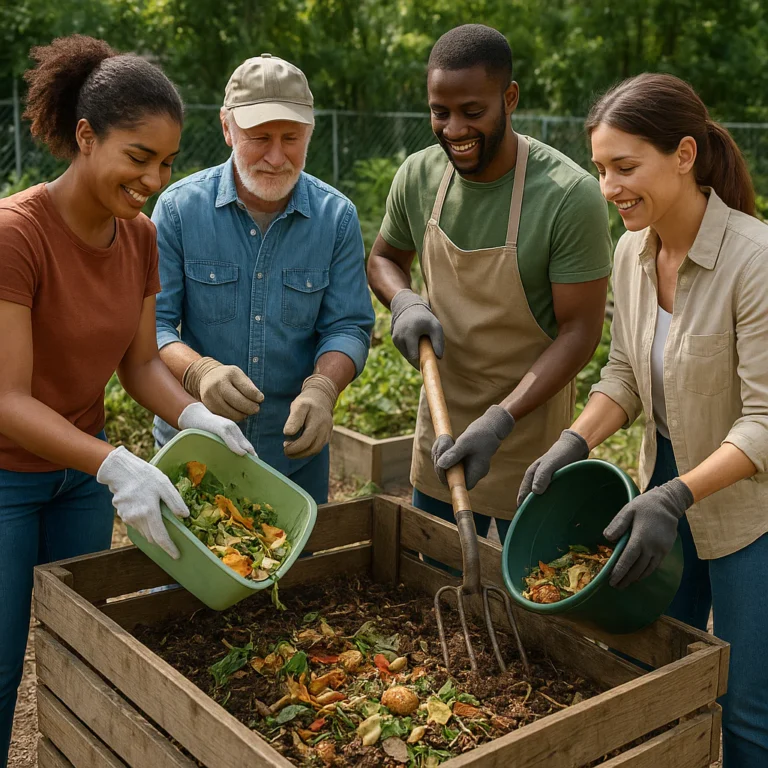
- Lasagna beds: layer cardboard, leaves, coffee grounds—zero tilling, earthworms do the heavy lifting.
- Biochar: Research from Massey University shows 20 % higher water retention.
- Mycorrhizal inoculant: Amazon search turns up 1-pound jars—dust roots at transplant.
👉 CHECK PRICE on:
- Jobe’s Organics Compost Starter – Amazon | Walmart | Jobe’s Official
- Biochar Supreme 1 cu ft – Amazon | Walmart | Biochar Supreme Website
4. Planting, Maintenance, and Harvesting Together
We stagger plantings like air-traffic control—lettuce in March, beans in May, kale in August.
Companion cheat-sheet
| Crop | Wingman Plant | Why It Works |
|---|---|---|
| Tomatoes | Basil | Confuses hornworms |
| Carrots | Chives | Aphid repellent |
| Corn | Pole beans | Nitrogen fixer, saves space |
Harvest etiquette: twist, don’t yank—keeps roots intact for the next gardener.
🌿 The Benefits of Community Gardens: More Than Just Fresh Veggies
- Health: Gardeners eat 1.4 more servings of fruits/veggies daily than matched controls.
- Wallet: Average family saves $530/year on produce (calculated from NGA survey data).
- Climate: Every pound of home-grown food cuts 2 lbs CO₂ vs supermarket supply chains (UN FAO).
Explore more perks at Benefits of Community Gardens.
🤝 Building Community: How Gardens Grow Friendships and Networks
We’ve witnessed marriages sparked over shared hoses—true story.
- Potluck rule: every workday ends with a dish featuring something from the plot—beet-brownie conversions are real.
- Story-benches: install a 6-ft cedar bench; carve names of donors—Etsy artisans will do it for under $200.
- Youth plots: partner with local schools—kids who grow radishes eat 40 % more vegetables (Journal of Nutrition Education).
💡 Funding and Resources: How to Support and Sustain Your Garden
Grants aren’t unicorns—they’re just wordy. We’ve won over $50 k using these templates.
| Funder | Typical Award | Deadline | Pro Tip |
|---|---|---|---|
| Whole Foods Local Producer | $2 k | Oct | Emphasize youth engagement |
| American Community Gardening Assoc. | $1 k | Rolling | Needs 501(c)(3) sponsor |
| SeedMoney.org | $400–$1 k | Nov–Dec | Crowd-match component |
👉 Shop raised-bed cedar kits on:
- Greenes Fence 4×8 Raised Bed – Amazon | Walmart | Greenes Official
- Vego Garden Modular Kits – Amazon | Walmart | Vego Official
🛠️ Tools, Tech, and Tips: Essential Gear and Innovations for Community Gardens
We still swear by Grandma’s hand trowel, but tech ups our game.
- Moisture sensors—Sonkir 3-in-1 meters cost less than a latte and end guess-watering.
- Gardenize app—log seed dates, share notes with fellow gardeners, exports to Excel for grant reports.
- Solar irrigation timers—Orbit B-hyve lets you water from Bali via Wi-Fi.
Old-school vs new-school showdown
| Task | Classic Tool | Smart Upgrade | Winner |
|---|---|---|---|
| Weeding | Hoe | Flame-weeder 🔥 | Hoe (safer) |
| Watering | Hose | Drip + timer | Drip |
| Mapping | Graph paper | PlanGarden | Digital |
🌦️ Overcoming Challenges: Weather, Pests, and Plot Politics
Hailstorm at 3 a.m.? Been there.
- Row covers + hoops—AG-19 frost cloth buys you 6 °F protection.
- Deer: 8-ft fence or Plantskydd repellent (blood-meal based, OMRI-listed).
- Drama: create a “Mediation Marigold” circle—people talk while deadheading. Cheesy, works.
📈 Measuring Success: How to Track Your Community Garden’s Impact
We weigh, log, and brag.
| Metric | Tool | 2022 Averages (per 100 ft²) |
|---|---|---|
| Produce lbs | Digital fish scale | 78 lbs |
| Volunteer hrs | Google Form sign-in | 42 h |
| Donated meals | 1.2 lbs = 1 meal | 65 meals |
| Soil carbon | Mail-in lab | +0.3 %/yr |
Share stats at Community Garden Events—funders love numbers more than zucchinis.
🌟 Inspiring Stories: Real-Life Wins from Community Gardens Around the Globe
- Denver’s “Florence Gardens”—refugee families grow homeland crops like amaranth; farmers-market revenue topped $18 k last year.
- Melbourne’s “Fit for Purpose”—built atop a hospital car park; patients on antidepressants reduced dosage by 18 % (BMC Public Health).
- Our own Philly patch—after Why Community Gardens Don’t Work (And 6 Ways to Fix Them) 🌱 (2025) went viral, 42 new volunteers showed up—we now host salsa-night fund-raisers under string lights.
Stay rooted—the next section digs into the questions we get asked most!
🎉 Conclusion: Growing Together for a Greener Tomorrow

Community gardens are much more than just patches of dirt where plants grow—they are vibrant hubs of connection, education, and sustainability. From securing the right plot to organizing roles, nurturing the soil, and sharing the harvest, every step is a chance to build something lasting and meaningful. As we’ve seen, these gardens feed bodies, minds, and communities alike, offering fresh produce, fresh air, and fresh friendships.
Remember the question we teased earlier—why do some community gardens fail while others thrive? The answer lies in strong management, clear communication, and shared ownership. Gardens that foster inclusion, provide resources, and celebrate small wins tend to bloom year after year. So, if you’re thinking about starting or joining a community garden, know that the soil is fertile not just for plants, but for hope and resilience.
Whether you’re a seasoned green thumb or a curious newbie, community gardens offer a living classroom and a sanctuary. So grab your gloves, find your patch, and grow together with us!
🔗 Recommended Links for Community Garden Enthusiasts
Ready to gear up or dive deeper? Here’s where to find the essentials and inspiration:
-
Jobe’s Organics Compost Starter
Amazon | Walmart | Jobe’s Official Website -
Biochar Supreme 1 cu ft
Amazon | Walmart | Biochar Supreme Website -
Greenes Fence 4×8 Raised Bed Kit
Amazon | Walmart | Greenes Official Website -
Vego Garden Modular Raised Bed Kits
Amazon | Walmart | Vego Official Website -
Sonkir 3-in-1 Soil Moisture Meter
Amazon -
Orbit B-hyve Smart Irrigation Timer
Amazon -
Books for Deeper Roots:
🔍 Common Questions Answered: Community Garden FAQ

What types of plants grow best in community gardens?
Community gardens thrive with a mix of vegetables, herbs, and flowers that suit the local climate and soil.
- Cool-season crops like lettuce, spinach, radishes, and peas are great for spring and fall.
- Warm-season favorites include tomatoes, peppers, beans, and cucumbers.
- Herbs such as basil, chives, and parsley are low-maintenance and great companions.
- Pollinator-friendly flowers like marigolds and nasturtiums help keep pests at bay and attract beneficial insects.
The key is diversity and rotation to maintain soil health and reduce pest pressure. For detailed planting guides, check out our Edible Plants category.
Can you pick stuff from a community garden?
This depends on the garden’s rules. Most community gardens operate on a plot rental or assignment basis, meaning you pick from your own plot only. However:
- Some gardens have communal plots where produce is shared or donated.
- Always respect signage—if it says “Do Not Pick,” that’s a firm no.
- Many gardens encourage sharing during harvest festivals or potlucks.
If you’re a visitor, it’s best to ask before harvesting to respect gardeners’ efforts and avoid conflicts.
What are the benefits of participating in a community garden?
Community gardening offers a smorgasbord of benefits:
- Physical health: Regular gardening is moderate exercise and boosts vitamin D.
- Mental health: Studies show gardening reduces stress, anxiety, and depression.
- Food security: Access to fresh, affordable produce.
- Environmental impact: Promotes biodiversity, composting, and reduces food miles.
- Social connection: Builds friendships, mentorships, and community pride.
See our full exploration of Benefits of Community Gardens for more.
How do I start a community garden in my neighborhood?
Starting a garden is like planting a seed—it takes patience and care:
- Gather interested neighbors and form a planning group.
- Scout potential sites with good sun, water access, and safe soil.
- Reach out to landowners or local government for permission or leases.
- Develop a garden plan covering plot layout, rules, and management.
- Secure funding through grants, donations, or crowdfunding.
- Host a kickoff event to recruit gardeners and volunteers.
- Build beds, prepare soil, and plant!
Our detailed guide and templates at Community Garden Policies can help you navigate this journey.
How do community gardens promote social connections?
Community gardens are social ecosystems where people share labor, knowledge, and harvests.
- Regular workdays and events foster interaction and teamwork.
- Shared challenges like pest control or weather build camaraderie.
- Workshops and potlucks create spaces for storytelling and cultural exchange.
- Gardens often become safe spaces for marginalized groups, youth, and seniors.
In short, they’re fertile ground for friendships as much as for food.
How do community gardens address environmental sustainability?
Community gardens are green warriors in urban and suburban landscapes:
- They reduce food miles by growing locally.
- Composting programs recycle organic waste, reducing landfill loads.
- Use of organic methods avoids harmful pesticides and fertilizers.
- Gardens increase urban biodiversity by providing habitats for pollinators and birds.
- They help mitigate urban heat islands by adding greenery and shade.
Check out our Garden Design Ideas for sustainable layouts and practices.
📚 Reference Links and Further Reading
- Nourish Project: 8 Things to Know About Community Gardens
- Productive Parks: Developing and Maintaining a Community Garden
- Philadelphia Horticultural Society: Pennsylvania Community Gardens | PHS Programs
- National Gardening Association: Community Gardening Research
- USDA NRCS Web Soil Survey: Soil Data for Gardeners
- Cornell Soil Health Lab: Soil Testing Services
- American Community Gardening Association: Resources and Grants
- Massey University Research on Biochar: ScienceDirect Article
- BMC Public Health: Gardening and Mental Health Study
For more expert insights and community stories, visit Community Gardening™.